

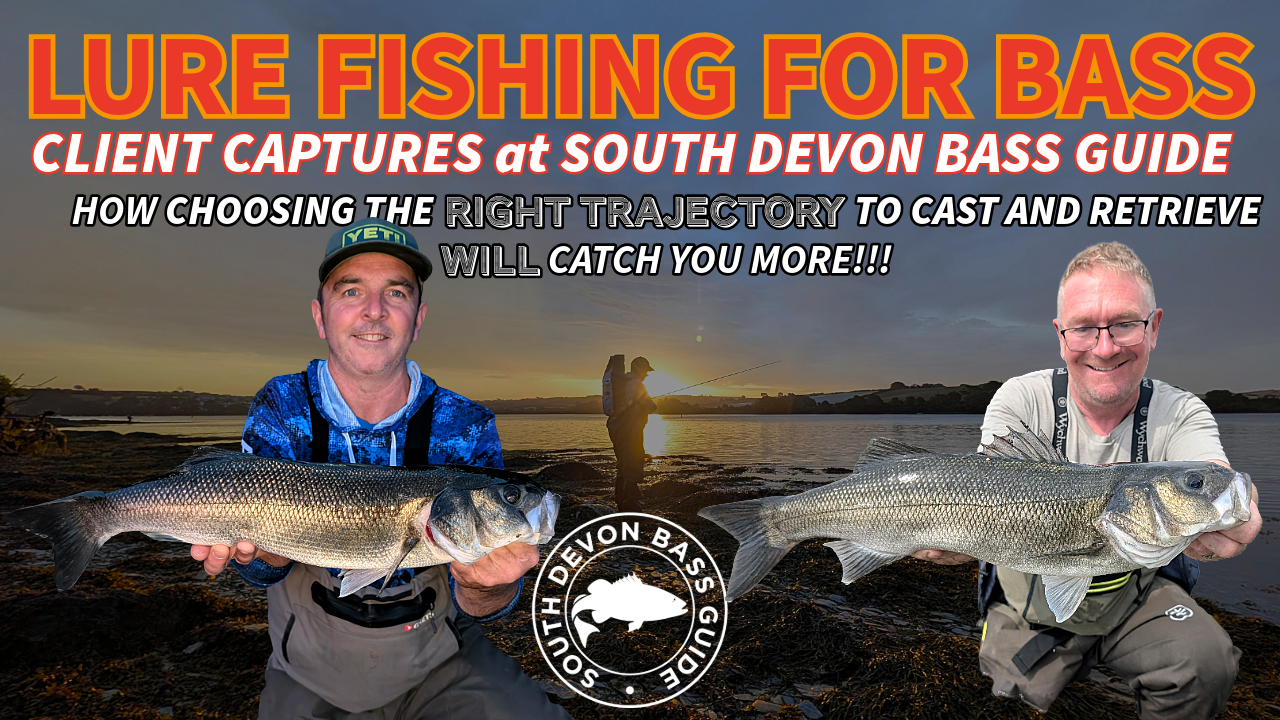
Two near 60cm bass, both caught by clients on their first proper session using a Megabass Sleeper Craw creature bait, came from the same fundamental principle: put the lure where the bass are naturally travelling.
That sounds simple, but it is the difference between casting generally and casting with a real purpose. On this particular 3 Day Package, the two captures came from very specific ‘lanes or trajectories’ as it were.
- One was a narrow gap between weed patches in shallow water.
- The other was a tide crease where clearer and murkier water converged.
The lure, retrieve and conditions were slightly different in each case, but the thinking was the same. Do not simply think like a fish. Think like a bass.
WATCH, READ OR LISTEN…
TO WATCH – Please click on the image below – this will take you to my South Devon Bass Guide YouTube Channel.
TO LISTEN – Please click on the link to my Spotify Page.
TO READ – To read, then please read a post created via my original video production via the AI Platform – Video to Blog.
Key Takeaways
- Target natural bass routes such as weed gaps, margins, creek mouths and tide creases.
- Use the lure’s splash as an attractant when intercepting bass travelling in fast moving water.
- Make shorter moves in clear shallows and longer 50cm to 1m movements to the lure in murkier water or in darkness.
- Maintain tight contact on a hooked bass because it will often swim directly towards you in an attempt to ‘throw’ the hook.
Table of Contents
- Start With the Bass’s Likely Route
- Capture One: Working the Gap in the Weed
- Capture Two: Fish the Tide Crease, Not Just the Current
- Adjust the Retrieve to the Water Clarity
- Why Lure Choice and Positioning Matter Together
- A Practical Framework for Fishing Bass Trajectories
Start with the bass’s likely route
When the water starts getting shallower and the tide begins to pick up, bass do not necessarily travel wherever there is open water. They frequently use cover, structure, margins and natural passages to move efficiently while remaining in a position to intercept an easy meal.
At the first location, there was a main weed margin, then a series of smaller weed patches set in almost a straight line. Between them sat a narrow gap, only a couple of metres wide. Beyond that, there was essentially flat mud for perhaps 50 to 60 metres before the main channel.
That gap was the key. It created a natural corridor through which a bass could move while looking left and right into the weed for crabs, prawns, baitfish or anything attempting to scuttle away.
There is no guarantee that every bass will take exactly the same track. On a hot evening, a small group may well venture out over open mud in search of bait. But when the fish are lethargic, especially after sustained heat, sunshine and a lack of rain, an easy route tight to cover makes a great deal of sense – thinking like a bass remember…!
Warm, still conditions can leave bass reluctant to expend energy. Bigger fish in particular are always looking for a straightforward meal. In that situation, the weed margin and its gaps can be far more valuable than featureless open ground.
Capture One:
Working the gap in the weed
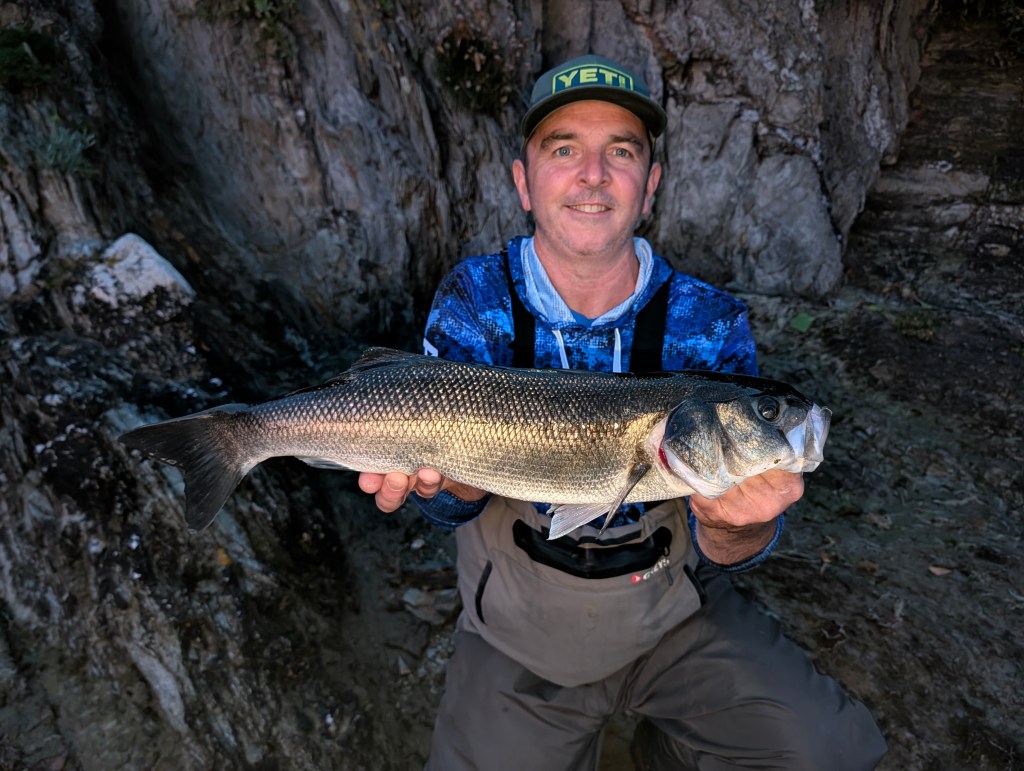
The first near 60cm fish was caught by my client Piney, only around ten minutes after he had landed a tiny bass, his first ever on a Sleeper Craw. The small fish gave a quick, rat-a-tat-tat take. The next one was a very different proposition.
The instruction was to cast repeatedly along the same precise trajectory, straight through the gap in the weed. Rather than fan-casting aimlessly, every cast was intended to put the creature bait into the route a travelling bass was likely to use.
Make the ‘splash’ work for you!
One point that is often overlooked in bass lure fishing is the value of the lure entering the water. The splash is not always a negative. In the right situation, it is a major attractant.
A bass travelling away (5-10m in my estimation) can detect that sudden disturbance and move to investigate with purpose, before finding the creature bait settling where a crab ought to be. That is exactly why contact matters immediately after the cast.
- Cast accurately along the chosen line.
- Keep a reasonably tight line as the lure lands and sinks.
- Know when it reaches the seabed.
- Move it almost immediately rather than allowing it to lie motionless.
In this instance, Piney was fishing in around 2ft of exceptionally clear water, while standing just below knee deep himself. The bass could easily have travelled very close by. The splash drew attention, the lure reached the bottom, he wound down, moved it once and the rod went over.
Use short moves and short pauses in clear, shallow water
With a Sleeper Craw or any crab-style creature bait in very shallow, clear water, subtlety is vital. The retrieve should imitate a crab edging backwards along the seabed:
- Make a short movement.
- Pause briefly.
- Move it again.
- Continue with short, controlled increments.
As the water becomes clearer and shallower, shorten both the movement and the pause. You are not trying to drag the lure great distances. You are creating the impression of a vulnerable little creature moving naturally along the bottom.
The take initially felt deceptively modest because the bass had picked up the lure and continued swimming towards the angler with the tide. That can create slack line and disguise the true size of a fish. It is also exactly what a good bass may do in an effort to shake the hook or reach the nearest weed clump.
The result was a pristine 57cm bass and a very memorable first significant creature-bait capture for Piney, and of course, a very happy guide!
Capture Two:
Fish the tide crease, not just the current
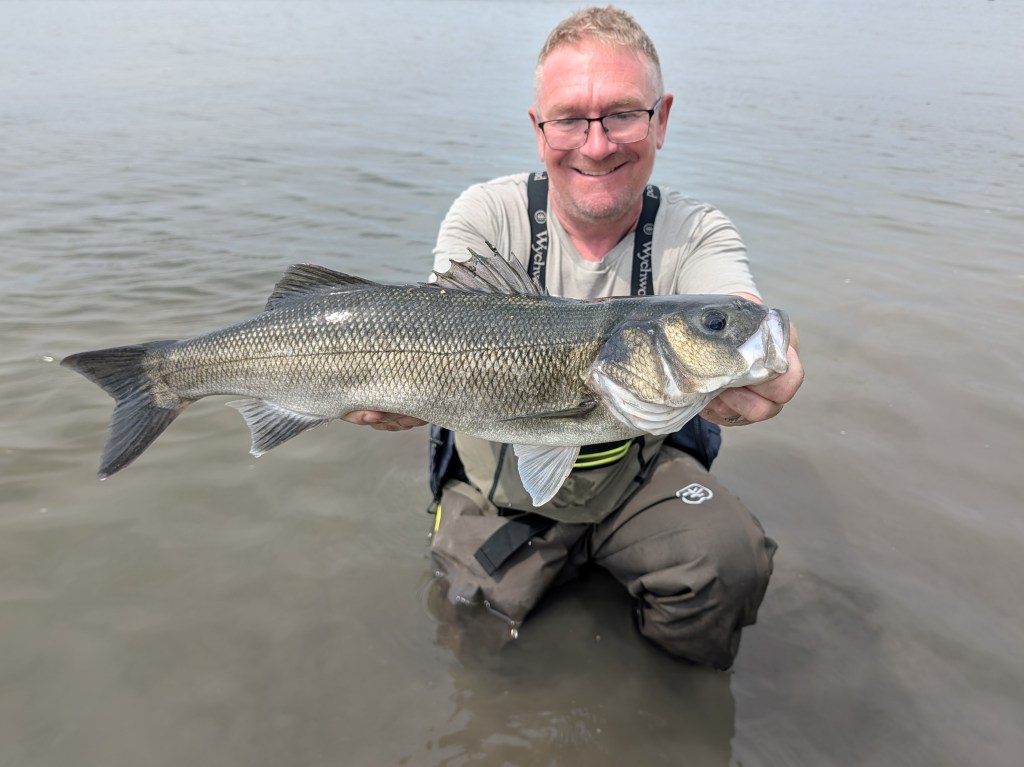
Rob’s fish, another superb bass at VERY close to 60cm, came from a faster-moving stage of the tide – the 2nd to 4th hours in fact. The difference here was that the likely route was not simply a gap in weed. It was the outside edge of the main tidal crease as bass moved up through the main body of the estuary and towards the mouth of a creek.
A tide crease is an obvious line where two flows or water types meet. In this case there was dirtier, stirred-up water on one side and clearer, faster-running water on the other. That convergence was the lane to work.
Think about what a bass is doing as it travels in the flow. It can keep one eye on baitfish moving with the tide, while still checking the margins for crabs, prawns and other easy food. The edge of the flow is an ideal place to do both.
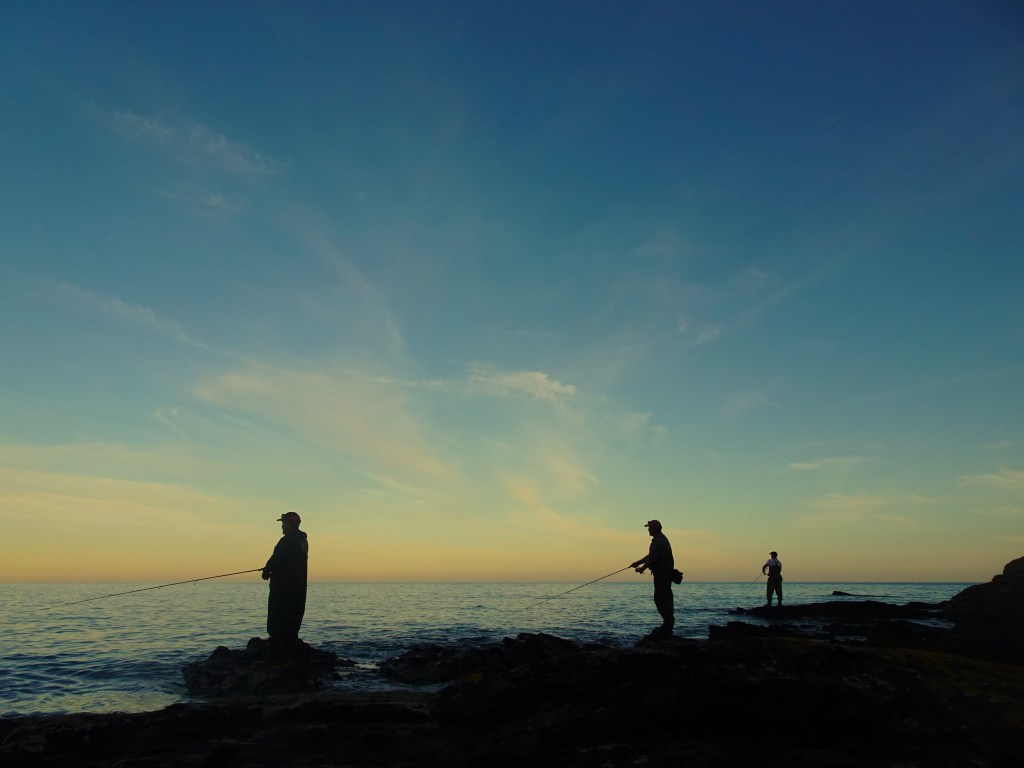
Rather than continually moving around after resident fish, the three anglers were positioned along a chosen area and asked to wait for the bass to patrol through. The plan was to keep presenting lures along the same route, cast after cast, until a fish arrived.
Why shorter retrieves can create more opportunities…
Where the seabed is clean and the water is very murky, there are times when retrieving the lure all the way back to the rod tip is perfectly sensible. But that was not the situation here. There was green salad weed, dead bladderwrack and debris scattered over gravelly ground here, with material accumulating in little depressions and around any stones. Dragging the lure all the way through that was not the most efficient approach.
Instead, after the lure splashed down and reached the seabed, the instruction was to retrieve it perhaps halfway, wind in and cast again. This did two useful things:
- It reduced the chance of fouling the lure in the messy ground close in.
- It created more splash-downs and more opportunities to attract a passing bass.
It may sound slightly bizarre, but that splash can genuinely be the trigger. Previous winter fishing had shown this very clearly, with bass taking lures during the descent in darkness, rather than on the retrieve. No bites came while winding, yet the splash and level sink produced the takes when using certain soft plastics. In fast-running water, that initial disturbance can be especially effective. A bass travelling in the flow senses the splash, deviates from its route and investigates the source.
Adjust the retrieve to the water clarity
The first fish was taken in exceptionally clear, shallow water, so it called for tiny movements and tiny pauses. Rob’s fish was caught with around 3ft of water, where visibility was lacking due to the rising tide and flow stirring the mud from the foreshore, with a light breeze adding further colour to the water by virtue of the wavelets being created.
In that murkier water, the lure could be worked more positively. Bass may not see the bait as readily at range, but they can certainly detect the vibration, noise and displacement created by a creature bait moving along the seabed.
The method was straightforward:
- Cast just outside the main tide crease, along the boundary between clearer and murkier water.
- Stay in contact as the lure hits the seabed.
- Make roughly a half-turn to a full turn of the reel, moving the lure around 50cm to 1m.
- Pause for around 3 or 4 seconds.
- Repeat the movement and pause, keeping the lure in the productive lane, and that delightfully-named ‘kill zone’.
The longer movement gives off more vibration. The slightly longer pause gives a bass time to locate the source, approach it and eat it. It is not just about the lure being visible. It is about giving the fish every possible sensory cue and enough time to respond.
Why lure choice and positioning matter together
All of the three anglers on this 3 Day Package were using different lures and approaches at this juncture. One was using a paddle tail, another a surface popper, while Rob was positioned first in line with the Megabass Sleeper Craw – the most subtle lure of the three as it were.
That positioning was deliberate. If bass were travelling through the zone, Rob would encounter them first. The subtle, bottom-oriented creature bait gave the fish a natural offering before they reached the more active presentations further along.
There is no single lure that covers every eventuality. A paddle tail can create an immediate visual and vibrating target after a splash. A surface lure can be outstanding in the right circumstances. But when bass are following weed lines, creek mouths or tide creases and looking for bottom-dwelling food, a creature bait worked slowly on the seabed can be a brilliant option.
Rob had made only a handful of small pulls when he felt a lovely tap and the rod bent over. Just like the first capture, the bass swam directly towards him, initially making it feel smaller than it was. That is when experience, tight line management and a landing net ready to go (via the guide who made his best at ‘cocking it up!) make all the difference.
A practical framework for fishing Bass trajectories
These two captures were not about finding a magic cast or blindly relying on a particular lure. They came from reading the water and building a logical plan around bass behaviour.
Use this framework whenever you approach an estuary, creek or shallow coastal margin:
- Identify the structure: Look for weed edges, isolated weed patches, gullies, creek mouths, current seams and colour changes.
- Find the travel route: Ask where a bass can move while using the structure to search for food.
- Match the cast to the route: Repeatedly present the lure along that specific line rather than spraying casts everywhere.
- Use the splash deliberately: In moving water or when intercepting travelling fish, the splash can bring a bass to the lure.
- Modify the retrieve for visibility: Use shorter, more restrained moves in clear shallows and slightly longer pulls in coloured water.
- Keep contact: Be ready from the moment the lure lands, because the bite may come immediately.
- Expect a bass to run towards you: A fish swimming in your direction can create slack and feel far smaller than it really is.
Both fish were released successfully after a brief time out of the water. That is always a lovely ending to a capture, particularly when it is somebody’s first proper bass on a new lure type.
Ultimately, fishing a lure along a specific trajectory is about stacking the odds in your favour. Read the weed. Read the current. Read the water colour. Then put the bait where a bass is most likely to travel, and work it in a way that fits the conditions.
Bookings and Availability
If you would like to enquire about the subjects below in relation to our professionally guided bass lure fishing session/lessons please complete the Contact Form below and I will endeavour to respond as soon as I possibly can:
- My (Marc Cowling) 2027 Availability.
- My 2nd Guide Joe’s Remaining 2026 and 2027 Availability
- If you would like to be added to my/our Reserve Lists or Mailing Lists respectively.


