

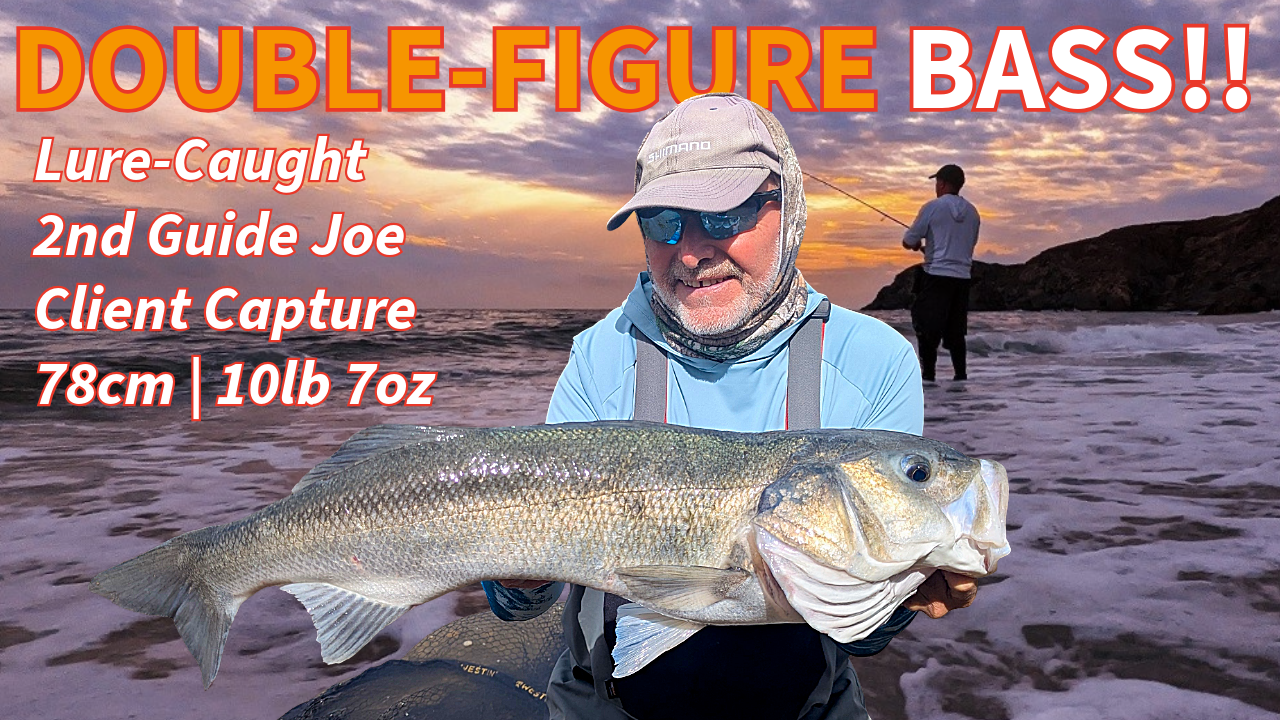
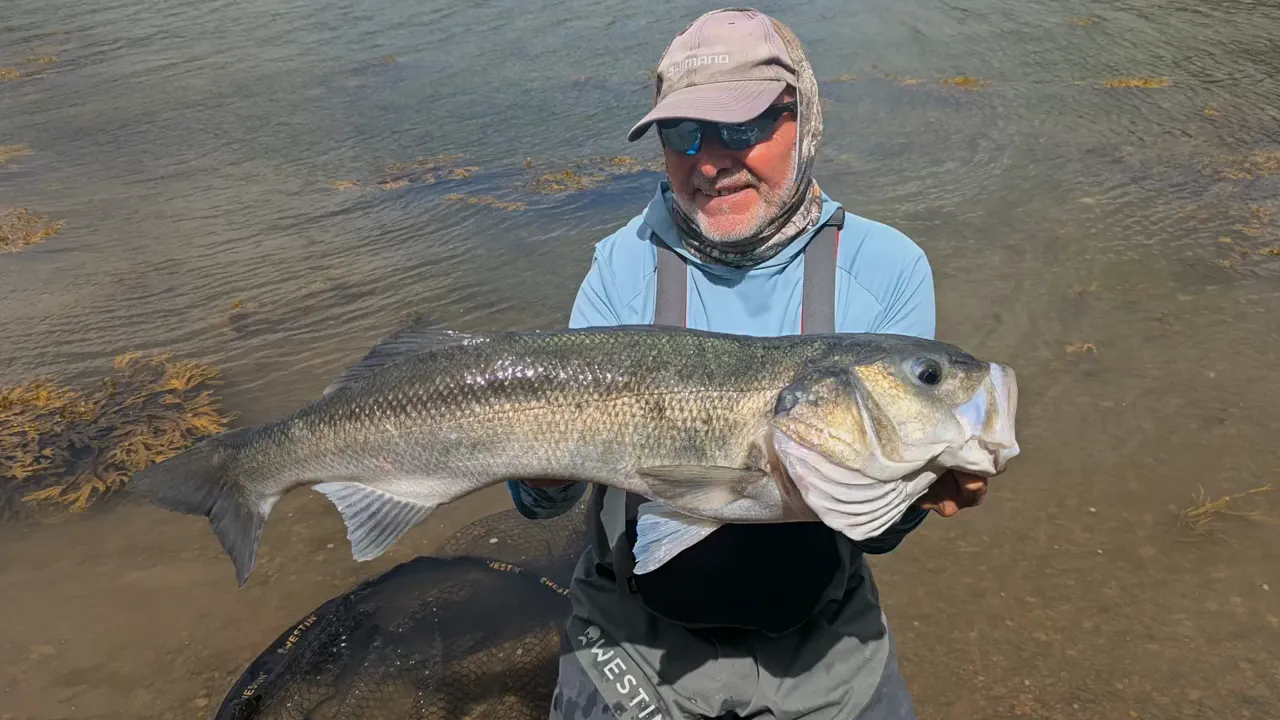
78cm, 10 lb 7 oz, and an absolutely magnificent bass. That was the fish my 2nd Guide Joe helped his client Mark catch during a six-day spell of guided fishing in South Devon. A proper double, and our second of the season after the 80cm bass I had with a client back in May with my client Alfie (here)
There is plenty to celebrate here, but the details of how it happened are just as interesting as the size of the fish. Weed clumps, an ebbing tide, a little pocket of swirling current and a creature bait worked with small hops all played their part.
WATCH, READ OR LISTEN…
TO WATCH – Please click on the image below – this will take you to the South Devon Bass Guide YouTube Channel.
TO LISTEN – Please click on the link to the South Devon Bass Guide Spotify Page.
TO READ – To read, then please read below a post created via the original video production via the AI Platform – Video to Blog.
I spoke to Mark afterwards to get his side of the story. What follows brings together his account, Joe’s observations and the features of this fishing that I find particularly useful.
A 60cm Bass to Start the Trip
Mark had booked two consecutive three-day packages with Joe. On what I believe was the very first session of the first package, he caught a 60cm bass on a Megabass Sleeper Craw creature bait. Not a bad way to begin!
That fish came from a creek where the water narrowed and shallowed. There were plenty of mullet about, which is something worth paying attention to.
I have long known that bass mix with mullet, but the drone footage I have captured, along with increasingly frequent sightings, has really reinforced it this season. You might see ten mullet with a single bass sitting beneath them. Sometimes the bass moves around the group; sometimes it holds its position while the mullet swim around it.
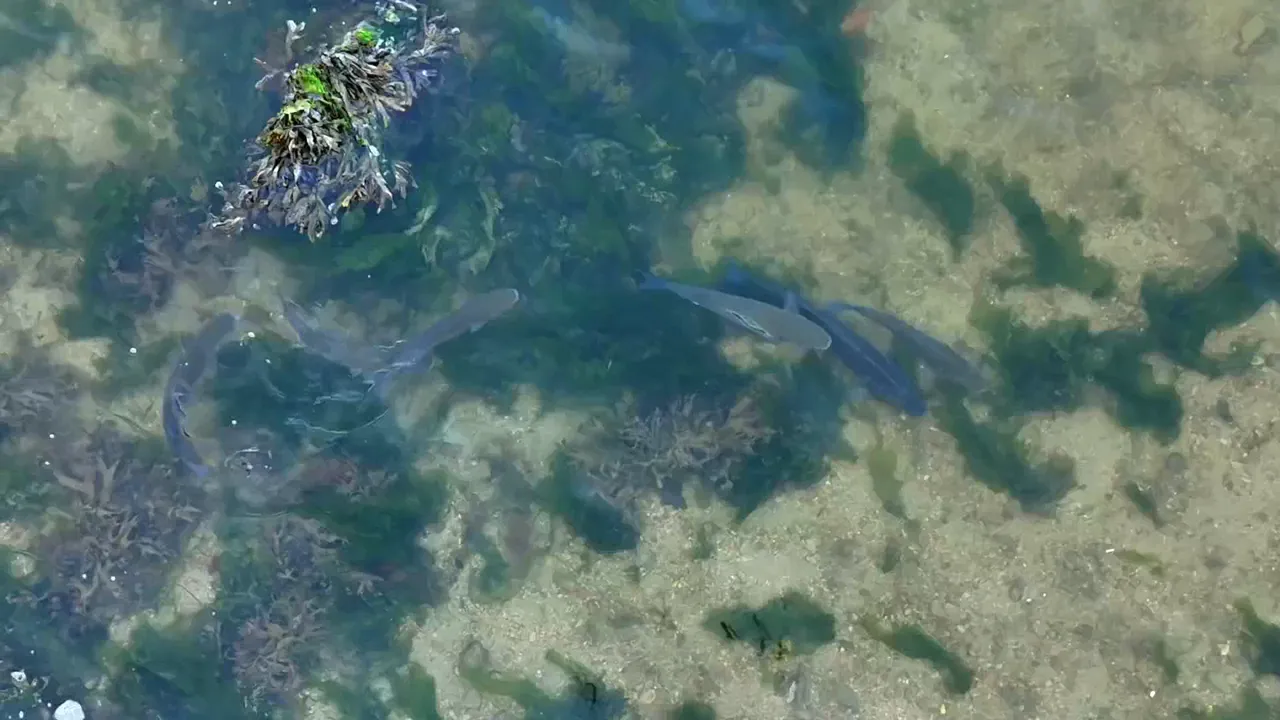
I suspect something similar may have been happening when Mark caught that first fish. Having chatted to him about it, he agreed it was possible. We cannot say for certain, but a gathering of mullet is not a reason to assume there are no bass nearby.
Why I Like to Fish Across the Turn of the Tide
The other interesting detail was the timing: that 60cm bass came at the turn of the tide.
When I plan guided sessions, both my own and Joe’s, I often try to arrange them so they straddle that change. Even with a four-hour session, I like to include either:
- The approach to low water and the beginning of the flood.
- The approach to high water and the beginning of the ebb.
It is often a very good time to be fishing. That does not mean every worthwhile fish comes at the turn, as Mark’s double would demonstrate, but it is a feature I regularly build into our session planning.
Across the six days, Mark also caught a number of smaller bass on various lures, including a couple of fish around 50 centimetres on creature baits. There was already plenty of good fishing behind him before the main event.
Working the Weed Margins on an Ebbing Tide
The big fish came on day one, session one, of Mark’s second three-day package. He certainly seemed to have a knack for getting his packages off to a good start!
Mark is an experienced angler, primarily from a freshwater background. He fishes with both bait and lures, particularly for chub and perch. That experience mattered. He already had good rod-handling skills, and the techniques Joe described made sense to him because he had something familiar to relate them to.
For this session, Joe took three clients to an area where the tide was ebbing, at roughly mid-tide. He initially positioned them around 40 to 50 metres apart and gave them a straightforward brief: put the creature bait into the margins, tight to the weed, and into the little holes and gaps between it.
The approach was not to stand in one place and keep repeating the same cast. Joe wanted them to work their sections methodically:
- Make a couple of casts into a promising gap or pocket.
- If nothing takes the lure, move and change the casting angle.
- Cover the same feature from the new position, or move to another small section.
- Keep placing the lure into different likely holding spots.
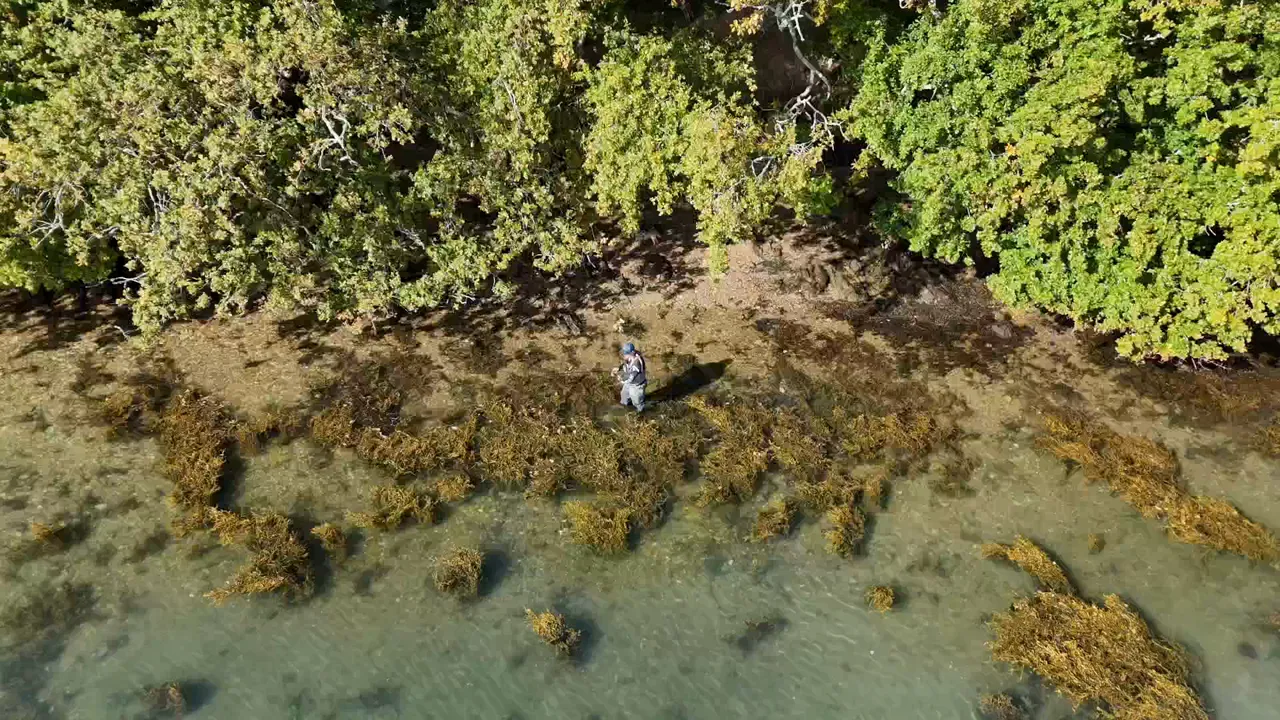
Mark was in the middle. Another client, also called Mark, was to his left, working along a fairly distinct line of weed. The ground in front of the eventual captor was different: more of a bowl containing gravel, weed and separate weed clumps.
The current naturally swirls and forms back eddies there. It is also somewhere Joe and I have both seen really big bass. I had seen a sizeable fish in that area a couple of weeks beforehand. I would not have called it a ten-pounder, but it was certainly a good one.
So this was not simply an attractive-looking patch of water. We knew that some large fish frequented it.
Joe continued to the right with another client, trying to sight fish for bass moving down in the flow and into the weed. By the time Mark hooked his fish, Joe was probably 100 to 150 metres away. His instruction to Mark had been to keep covering those different pockets, because bass move in, settle for a time and then move back out.
The Little Hops That Led to the Take
Although the earlier fish had taken a Sleeper Craw, Mark was now using a Bass Lures UK Creature Bait, a similar style of lure in a reddish colour. Whether that colour had any bearing on the result, I honestly do not know.
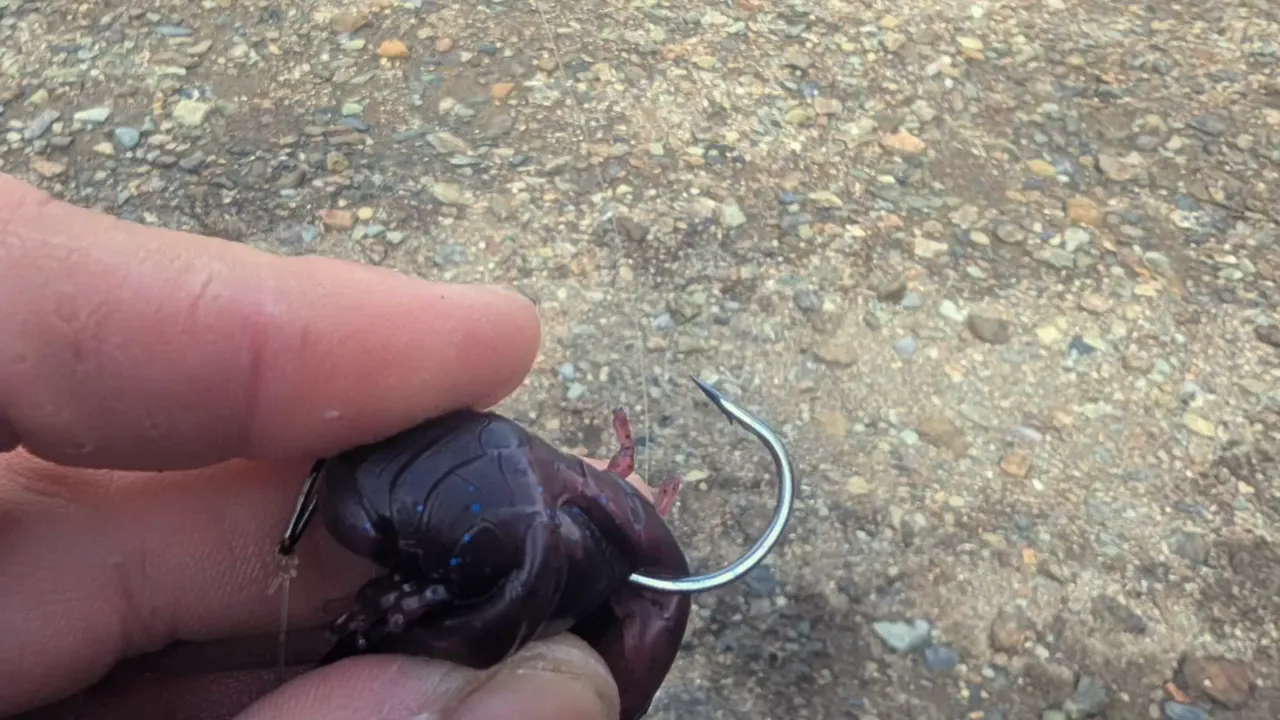
Before the decisive cast, Mark brought the lure close and gave it a few small hops. He wanted to see how it sat and how the claws reacted to the movement. He liked what he saw.
That was a familiar action from his perch fishing. Rather than learning an entirely alien technique, he was applying something he already understood to a different species and setting.
On the next cast, he put the lure into a slightly different area, wound down to make contact, moved it once, then moved it a second time. Everything went solid….
There was no obvious tap, just sudden resistance. With weed clumps dotted all around, his first thought was that he had caught the weed. He pulled into it, and the fish promptly went absolutely ballistic.
That initial solid feeling is something I recognise from big bass. Sometimes there is a brief hit followed by a moment when very little seems to happen. Then the fish starts moving and you discover exactly what you have connected with.
In Mark’s case, the change from apparent weed to a powerful running fish was unmistakable.
A Powerful Fight Along the Margins
The bass stripped plenty of line from Mark’s spool. First it pulled him round to the right, running parallel to the margin. Then it turned and came back to the left.
That was when Mark saw it just below the surface and realised how big it was.
The fish continued left and came close to getting into the weed. Mark described it trying to get its head down into the clumps, which I can completely appreciate. All the while, he was calling for Joe.
Joe is a very fit, ex-military chap, and he sprinted through the mud and water with the net to reach him.
Our briefing for clients fishing these particular margins includes what to do if the guide cannot get there with the net in time: bring the fish out rather than leave it battling in the weed. Mark followed that instruction and drew the bass up onto the gravel, with Joe arriving just as he did so.
Given the bulk of that fish and the fight it had put up, Mark did a very good job. Joe told me he could hardly believe its size. It was the biggest bass he had ever seen.
Just How Special is a Double-Figure Bass?
I drove down to congratulate Mark after the session, the day before I went on holiday. In the nicest possible way, I am not sure the scale of what he had achieved had fully sunk in.
He knew he had caught a very big fish. But double-figure bass are like rocking-horse droppings. They really are that special.
At that point, I had caught only one myself, an 83-centimetre bass. I had also guided one client to a double, the 80-centimetre fish earlier that season. Mark’s capture made three across those experiences: one for me personally, one for my client and now one for Joe’s client.
For South Devon Bass Guide, it meant two client doubles in the same season.
It was also our 20th client bass over 70cm. Eighteen had come through my guiding and two through Joe’s. That is a fantastic achievement for Joe, particularly as he had only been guiding full time for about twelve months. He had already helped clients catch some magnificent fish, and this was another very special milestone.
Recovery, Weighing and a Strong Release
After such a substantial scrap, looking after the bass came first.
They unhooked it in the net. Interestingly, the hook was just outside the mouth when they landed it. It had clearly held well throughout the fight. Whether it had shifted during the battle, I cannot say.
Joe then returned the fish to the water in the net and gave it a good few minutes to recover before taking it out again for photographs.
They weighed it using a wet sling, with the scales zeroed to account for the sling’s weight. The result was 10 lb 7 oz.
The photographs Joe took were fantastic, and the grin on Mark’s face said plenty. But for me, one of the best parts of the whole capture was the successful release.
Big bass do not appreciate being out of the water. You have to look after them, particularly after a hard fight. Joe and Mark did a great job of caring for this beautiful fish, and seeing it swim away made me genuinely happy.
Creature Baits Beyond the Summer
By the last week of September, this fish had left me feeling optimistic about the fishing still to come. I had a feeling it might not be our final double of the season, although that was anticipation, not a hint that another had already been caught.
There was talk of El Niño and the possibility of a rough autumn. Whatever the weather might bring, I still felt those creature baits had more to offer.
If settled conditions continued, with limited rainfall and without repeated storms or a really cold spell, I thought South Devon’s bass fishing could carry on being as good as it normally is through the winter period.
That optimism came from experience rather than simply from one exceptional fish. My winter catch records go back roughly seven to nine years, and over the previous two winters in particular, creature baits had been doing the business in daylight.
Joe guides throughout the year, including December, January, February and March. Winter bass fishing is very much part of what we do, not merely something squeezed in around the summer season.
There are further catch accounts on the South Devon Bass Guide and Marc Cowling websites, alongside the video productions and Spotify podcasts, for anyone who prefers reading or listening to more of these fishing stories.
Many congratulations to Mark on an extraordinary bass, and to Joe for helping make it happen. A well-worked piece of water, an experienced angler applying familiar lure skills, and a magnificent fish returned to swim away. What a result!!!
Bookings and Availability
If you would like to enquire about the subjects below in relation to our professionally guided bass lure fishing session/lessons please complete the Contact Form below:
- My (Marc Cowling) 2027 Availability.
- My 2nd Guide Joe’s Remaining 2026 and 2027 Availability
- If you would like to be added to my/our Reserve Lists or Mailing Lists respectively.


