

Client Catches – The Ultimate Trigger Point?
25 to 30 Year’s ago, when I was taking in everything that I possibly could in relation to the habits of bass (the excellent books and Sea Angler magazine articles written by Dr Mike Ladle primarily) there were two facets to his catches that remained a constant:
- Some movement to the water
- Twilight
Optimum
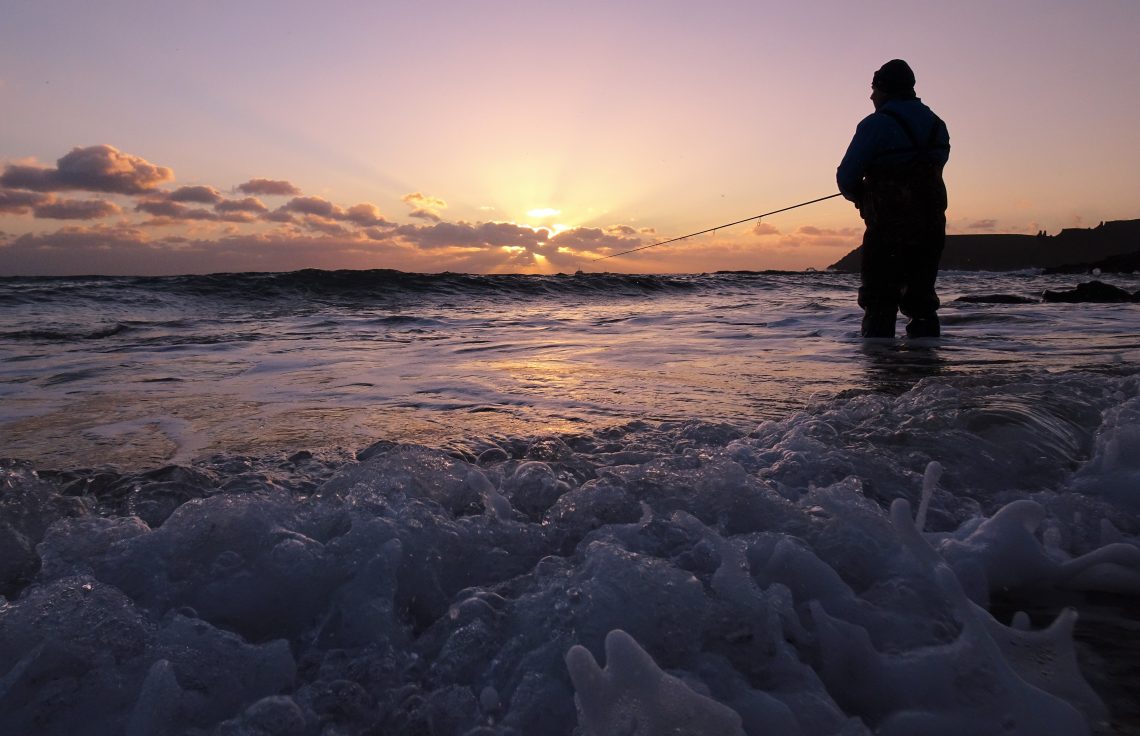
In regard to the movement to the water itself, this could be construed as either fast flowing water due to the tide and current, or of course, it could also relate to the motion of the waves and how it interacts with the shore. I’m thinking white, fizzing, aerated water crashing up the shoreline and over the rocks and reefs here – the quintessential ‘bassy’ conditions if you like. In relation to twilight of course, clearly this will encompass the relatively short dawn and dusk interludes.
But something that I have regularly considered, and that I am asked about on an equally regular basis is: were the lures that Mike and his friends were using in the late 80s and early 90s, (the highly successful, jointed, hard diving minnows such as the Rapala J11, J13, Storm Thunderstick and Rebel J20s and 30s) more suited to rougher seas and low-light conditions? Further, is this one of the reasons many bass lure anglers (including me) considered these types of conditions to be the optimum, and in some cases, the only periods in which to lure a bass?
Too good a look?
With the inspirational accounts from ‘Operation Sea Angler’ and ‘Hooked on Bass’ stirring my imagination and firing my enthusiasm, in my late-teens and early-twenties I would regularly visit a rugged and remote cove that I used to clamber around to during the summer holidays. With the only lures in my armoury at the time being a Storm Chug Bug, Duel Aile Magnet Minnow and Duel Aile Mag Popper, in addition to the hard minnows mentioned above, I would frequently witness ‘following bass’ that would literally have their nose on the rear treble of the dark-backed Rapala J11 as I brought it into view.
I know these bass hadn’t seen me, because I would cast and retrieve the lure from behind a large rock! Even so, would they take the lure in the crystal-clear, flat calm water while the light levels were high – even into late evening yet early into dusk? Would they heck- they were just getting too good a look at the lure in my opinion, and were, more than likely. just tracking it out of curiosity…
Validating what is purely a personal notion, the anecdote that introduces my first book ‘The Lure of The Bass’ (a title that has sold upwards of 3000 copies) describes such an event, that culminated in spectacular style once the light has dimmed enough so that the bass present wouldn’t and didn’t get quite such a good look at the lure, whereby they would decide to attack it once there was some doubt in their minds?
Conditions
So how does all of the above correspond to the lovely dusk-caught bass for my client (Jon) in the featured image? Well, one of the primary considerations for any bass lure angler, and one that I routinely facilitate in the course of my guided sessions, is that ‘matching’ the lure type to the overall conditions you’re faced with, be it the sea state, clarity, topography of the seabed, strength of current, what the bas may be hunting just to name a few, can be exceptionally important.
Augmenting the significance of lure choice even further, it does take time, either from reading up on the subject, watching others – be it in person or online, or by booking a guided session perhaps to understanding and appreciate what is or may be the ‘correct’ lure to attach at any given moment. Moreover, this also links directly into when to change the lure type for another – another accurate barometer of where you stand in the watercraft stakes…
Tasty!
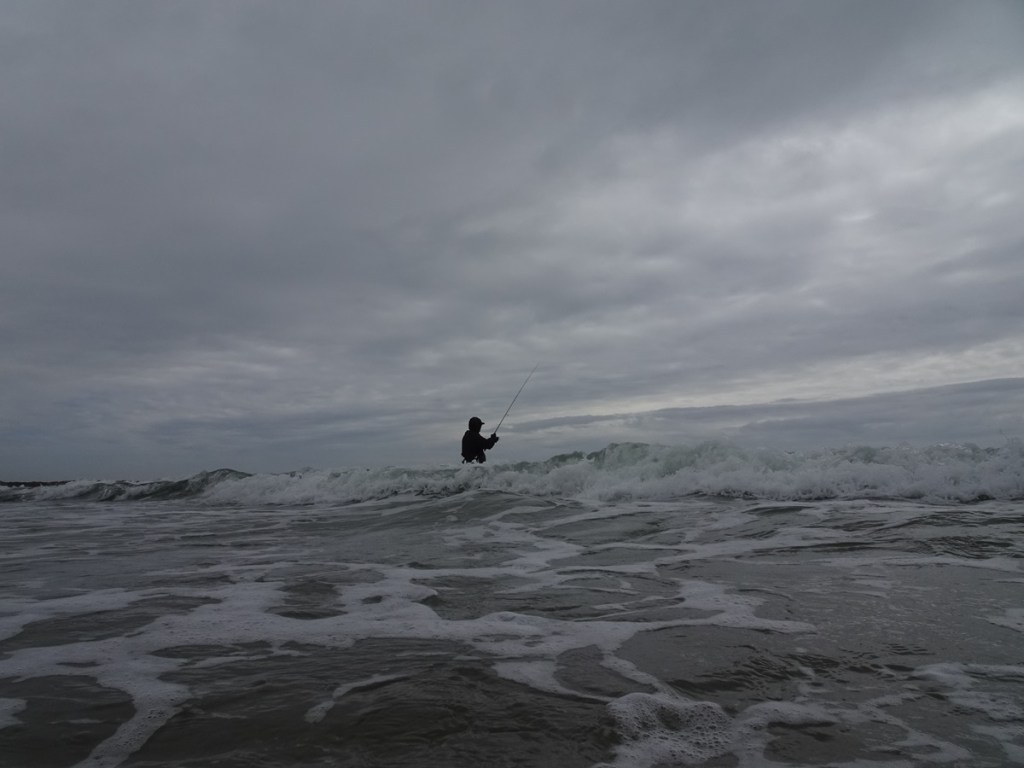
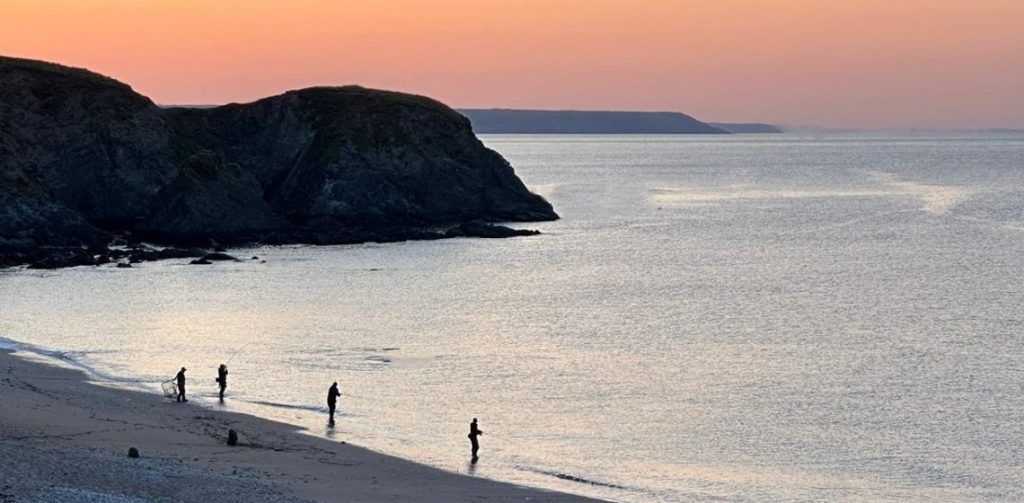
As we arrived on the beach, the darkening sky wasn’t entirely due to the evening drawing in, but in fact because a segment of heavy rain had remained menacingly close to the south-west Devon coastline. Indeed, by my estimation, the Net Weather Rainfall Radar had the remnants of the weather front that had seen it ‘peeing down’ all afternoon essentially pivoting back to into its mid-afternoon position, thus threatening to ruin Jon’s, mine, and my Border Terrier Bertie’s evening…
With a fairly flat sea washing into the cleaner, deeper, central section of the beach, yet with a lovely swell washing into and over the ‘reefy’ sections at each end/corner, it was a Patchinko 125, blasted and worked sporadically into the shallows that he tried initially. Following 30 minutes of casting and moving along the shore under my instruction, we reached the lefthand side of this beautiful bay – blimey it looked tasty in there!
As the tide turned, a 1m swell began to ‘stir’ those rockier and shallower alcoves at either end of the beach even more. Therefore, a change of lure was called for – one that would ‘dig into’ the waves and, at times, the powerful undertow where I’d suggested to Jon, the bass would be feeding if they were in residence tonight. So, on went Jon’s IMA Nabarone 125F…
Left, then right
For twenty minutes, Jon’s technique gradually improved under my guidance. You see, with this type of lure, it isn’t a case of chuck it out and wind it in – no, as I wrote in my previous blog post here, I would encourage you to imagine that a bass is behind the lure at every turn of the reel’s handle! Furthermore, as I cover in great detail within ‘The Lure of The Bass’ and within a series of blog posts that I will re-release in the coming weeks, there is an art to retrieving a hard, diving minnow – with maintaining contact/tension via speeding up and slowing down the retrieve as the force of the swell carries, holds and reacts with the lure and vice versa. There are other ‘tricks of the trade’ too…
But with the rain getting heavier and the sky darkening by the minute, I had a hunch that if a bass or two were sniffing around this stretch of shoreline, then it was going to the righthand side of this beach that was going to ‘throw one up’ as it were. The reason for this was twofold: a) the ebbing current/tide was now pushing into this corner, and b) there was a gorgeous gully situated here than just screamed BASS! to me…
The Trigger…
Talking Jon through the mechanics of each individual cast and retrieve as he recommenced with his fishing now at the opposite end of the beach, it was almost dark as he began to flick the Nabarone into the hotspot. “Make sure you can ‘feel’ the lure wriggling and vibrating as it enters the last few metres closest to the beach Jon, by speeding up the retrieve a bit and lowering the rod tip”, I said. “Will do Marc” came the reply…
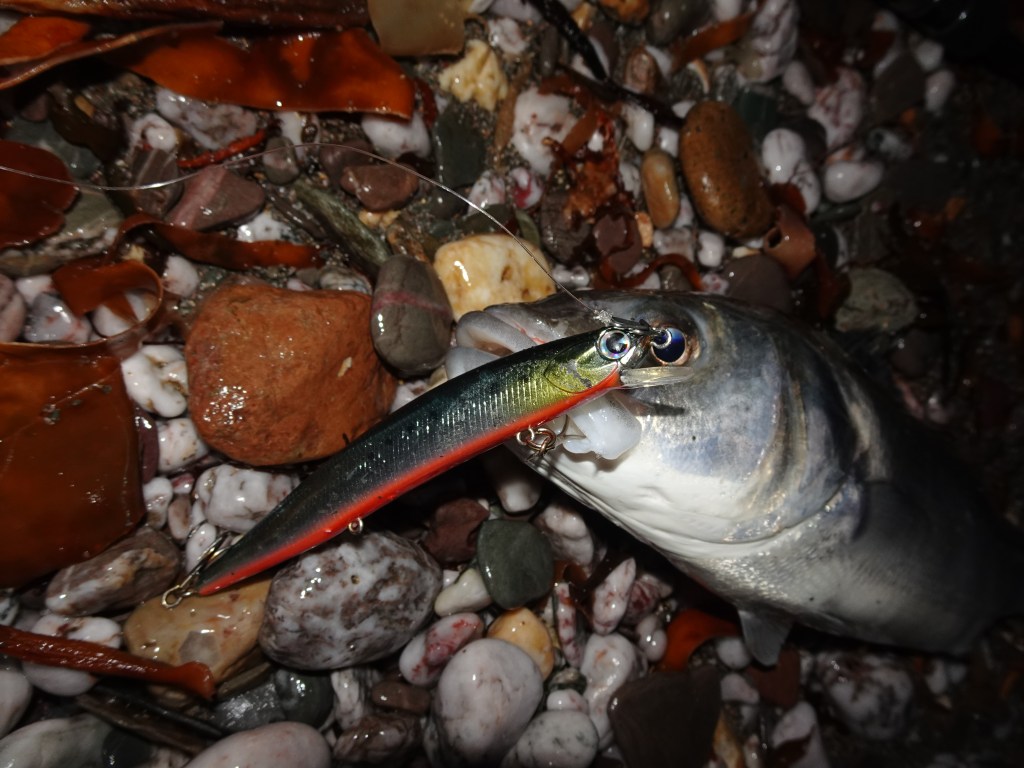
What a fantastic period in the session this was: the sea/swell building as the the tide/current began to increase, all in conjunction with what I believe is the ‘Ultimate Trigger Point’ – the few minutes in the day when dusk is about to become darkness… BANG! Bass on! Literally two metres from the beach, just as Jon had stuck to the task brilliantly by ensuring the lure was working as it should right into the shallows as a wave crashed up the shoreline and washed up to our thighs. The tactics, the lure choice, and his receptiveness had all combined to put his first bass of the 2024 season in his gleeful hands – the smile below said it all, despite the rain!

My Books
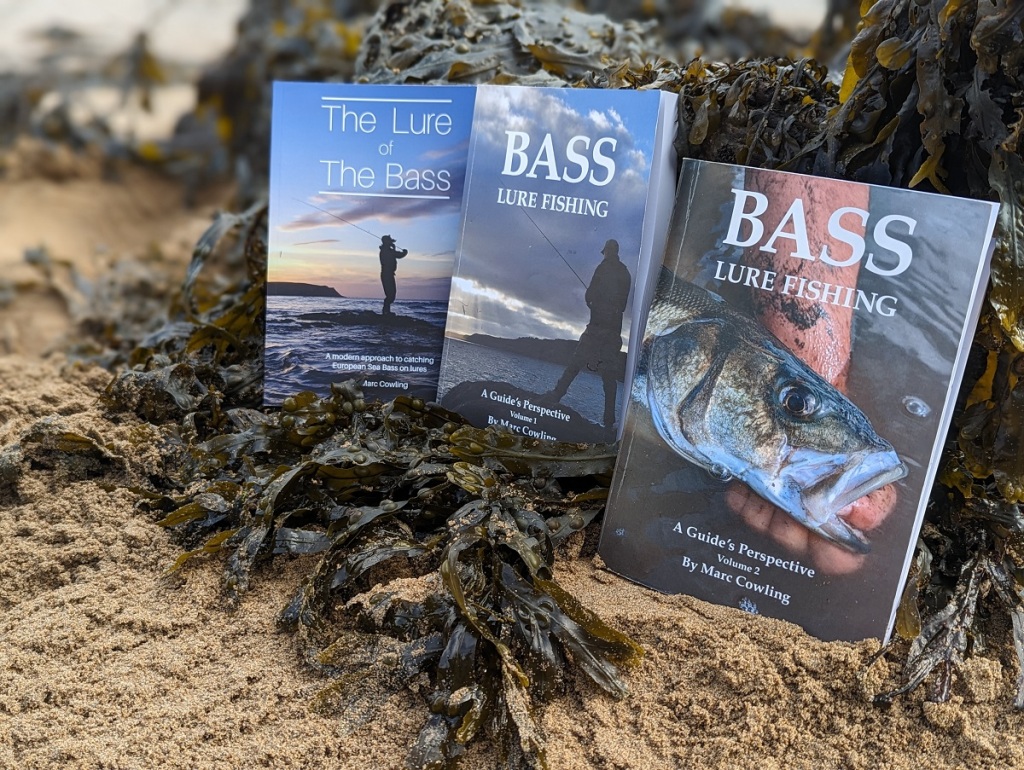
To find out more about my three books, that cover exclusively the ‘How, When and Where’ to catch bass on lures, from an all-encompassing range of environments, conditions, and lure types, I have written a blog post simply titled: ‘My Books – A Description of What is Encompassed Within Each…‘
Further, the availability status, in addition to PayPal payment buttons for each separate title can also be found via the link above. Alternatively, if you would like to enquire or indeed pay by BACS/Bank Transfer then I can either be contacted via the Contact Form below, or via my email address at: marccowlingblf@yahoo.com
2024/2025 Availability
Personally, I am FULLY BOOKED for the 2024 season. However, as you may have read on an earlier post, I have meticulously trained a 2nd Guide who has access to my 400+ bass, lure fishing marks. He will be conducting sessions over the weekends throughout this summer and into autumn. He is already getting booked up quickly therefore, if you would like to enquiry about or wish to attain his availability then please utilise either the Contact Form below, or email me at: southdevonbassguide@yahoo.com.


Thanks for reading.
Marc Cowling


