


Client Catches – The Concentration Cog
I did promise to write a number of ‘quick fire’ accounts in relation to the marvellous catches that my clients have achieved so far this season. Therefore, following on from the longer than expected ‘Real McCoys’ post that depicts some of the ‘cheapies or copies’ we have used to extract bass just recently (here) I wanted to publish something regarding another factor or component that has been exceedingly apt of late – the vital cog in the wheel that is maintaining or sustaining one’s concentration throughout a session of lure fishing for bass.

Expectant
As I’m sure you would have read, or at least ascertained from my books ‘The Lure of The Bass‘, and ‘Bass Lure Fishing – A Guide’s Perspective Volumes 1 (here) and Volume 2 (here) or via my fishing and guiding exploits on these pages, a lot of planning goes into what I do.

When I go fishing myself, the objective will be one of two things: to catch a substantial bass (55cm+) or to learn something about a venue/mark, be it a somewhere new, or that I regularly frequent. Likewise, as you or any paying customer would also expect, when I am guiding my clients, alongside the learning that is continually taking place, at every stage of a session, from the first cast until the very last, I will be expecting a bass to hit that lure.
You see, this (and the majority of decent bass anglers out there I suspect) is the way I am ‘programmed’ to fish, in the sense that I believe a bass can and will appear with every single turn of that handle. Blind faith? Perhaps! But what I am getting at is that I will never, ever place myself or a client in a position whereby I, they, or we, are just filling in the time.
Intercept or Search
As the saying goes: “even the best laid plans rarely go plan” which is why I will always have a Plan A, B and C in my back pocket… Sometimes the forecast weather isn’t as advertised, the swell charts inaccurate, or indeed, the overall sea state just isn’t what I’d envisaged. Therefore, when this occurs, as their guide, I need to be able to identify the problem, and then find a way to overcome it in order to place a bass on the end of that line – hence why there is a 121 Page chapter in my latest book (Bass Lure Fishing – A Guide’s Perspective Volume 2) devoted entirely to such events.

Bass are ‘eating machines’ who, as the sentence in the ‘Jaws’ films suggests: “swim, and eat, and make baby sharks” (or bass in this case) but there are periods with say a 24 hour cycle when they will be resting up, digesting, or simply taking a breather. Of even greater significance, as I wrote earlier this season here, something else to consider when you’re pursuing bass on lures is whether you’re attempting to intercept their movement by standing and casting into a specific zone (Patrolling Bass), or you are looking to search them out, via moving and casting to fish that are holding within a specific feature (Positioning Bass) – both of which are covered at great length in my first title: The Lure of The Bass (here).

Waiting or Moving
Taking the latter into account briefly then. If the lure you are presenting mimics either what the bass want or are anticipating (they are positioned yes, but on high alert as it were) or indeed, if you can garner a ‘reaction’ out of what could also be a resting bass, then if they are ‘at home’ you will know about it almost instantly! The third chapter, and a further 69 pages within A Guide’s Perspective Volume 2 are devoted to this via the ‘Marginal Gains’ that the angler can administer so to “wring every last drop enticement and allurement out of every single cast and retrieve…”

But the former, intercepting or pre-empting the predetermined movement of bass within a zone of tide, or along a predetermined route or trajectory between a reef or across a beach for instance – this is where persistence and perseverance massively comes into play. In essence, and as I have written previously, I would estimate that ‘waiting for the bass to come to us’ forms the basis of my/our approach 80% of the time.
Quiet
I don’t know if this appears daft or not to be honest, but sometimes, if you’ve already caught a number of bass, or have indeed already smashed your ‘Personal Best’ (as my client David did indeed do below) earlier in that session, it can be harder to maintain your levels of concentration for the remainder of the day than if you haven’t had a touch for the whole time you’ve been stood on that rock, beach, or foreshore…

I guess it comes down to many factors: such as how often you get to go fishing, what your PB is, or how long you’ve waited to attend or return onto one of my 3 Day Packages as was the case above! Either way, if it’s quiet, perhaps unusually so, then on the basis of being out on the wonderful south Devon coastline either fishing or guiding between 280-300 days a year (I don’t fish when I am guiding so the split is roughly 60% guiding and 40% fishing), if the chips are down, then console yourself with the notion that it could just mean that a larger than average bass is about to strike…!
Making it count
“Make every cast and retrieve count…” It sounds easier than it actually is, although this is a mantra I abide by courtesy of keeping my personal fishing sessions relatively short (3-4 hours) or by moving to a different area entirely, by car if necessary, and then resetting as it were if I wish to continue fishing. Therefore (and I do appreciate that I and anglers living closer to the coastline are fortunate here), if you are able to complete shorter sessions (such as the 6x 4 hour outings that I facilitate on my 3 Day Packages so that the guys and girls occasionally don’t burn out) it means that it is clearly less challenging to remain utterly focussed, than if you’re in for a marathon – so a more ‘dedicated duration’ if you like.
Keeping people motivated is part of my job, and it is second nature for me remain utterly alert to the potential for a big bass to sidle through on the tide/current – especially if it is the type of venue in which it can and has occurred, or indeed if the overall conditions (state of tide, sea state, a natural trigger such as dusk, darkness etc.) are in your/my/our favour. This can either be because you’ve increased the odds by planning accordingly, or as I intimated in a previous post here, the small bass just aren’t in residence which, I believe, allows the larger fish to ‘get’ to lure in their absence.
“One more cast”
We all say it don’t we… “One more cast!” However, on this occasion I’d actually said to my clients (Dave, Trevor and Pete) “have three more casts…” It’s possible that my bringing the session to a close motivated them into one last effort. But actually, in Dave’s case it just meant it was business as usual for the Whiplash Factory Spittin Wire that he’d been brilliantly ‘belly-rolling’ and gently ‘popping’ in the current for the past two few hours without a sniff after the initial glut of catches he’d accomplished (including his new PB don’t forget).
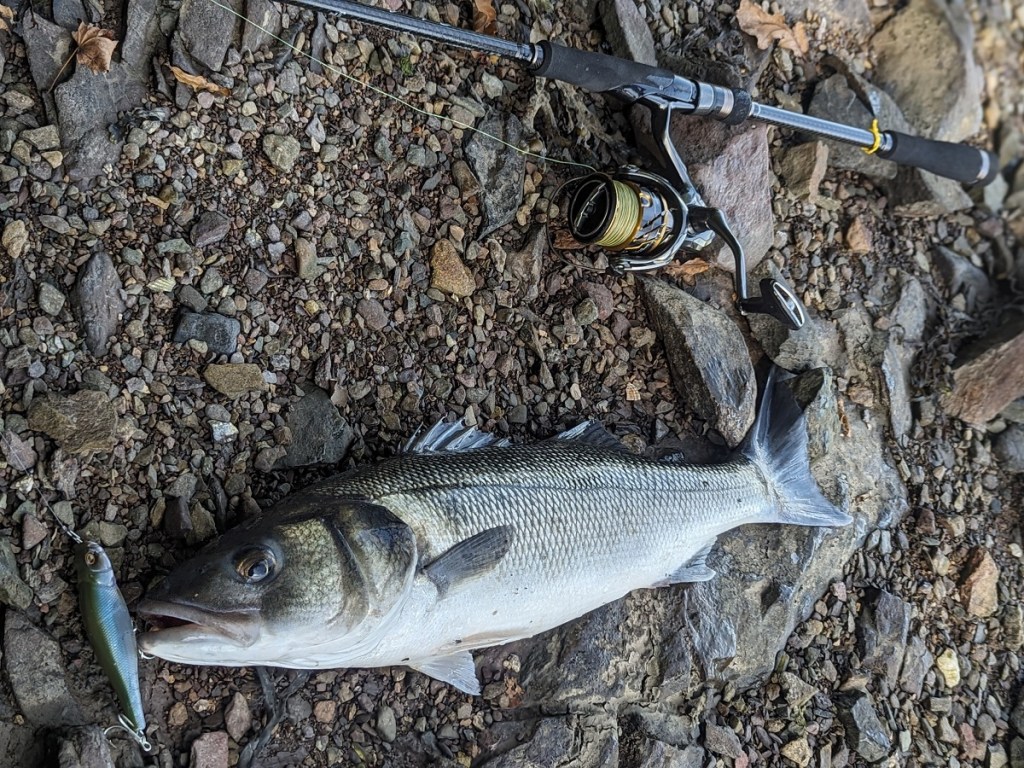
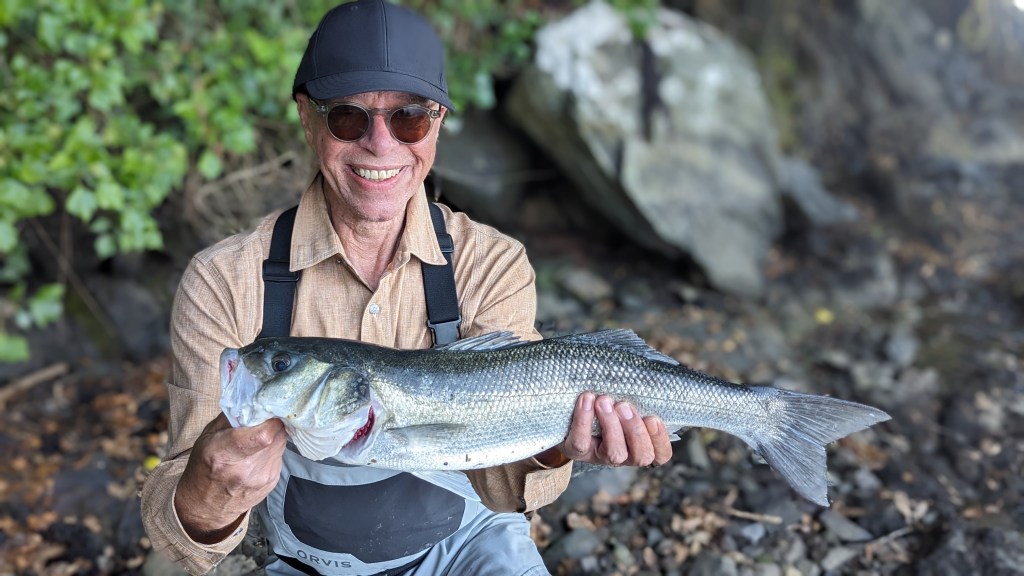
But… It wasn’t over…. Booooooshhhh!!! “Yeah, Marc – good fish!” is always music to my ears! What’s more, it justified my decision to remain on the mark, and to request that Dave remained in situ, waiting for the bass to come to him, and to keep the Spittin Wire attached – all of which took a great deal concentration and commitment to the cause. There were a few tense moments, more especially as I loomed with the net and she bolted, but even more so the next time she surfaced and I realised just how precarious the hook-hold was! But in she toppled – and what a beauty at 62cm.
Thanks for reading.
Marc Cowling


 South Devon Bass Guide Ltd