


Client Catches – A mention for the tension…
It’s been a while since I last sat down to write a blog post and I do apologise for that. There’s a good reason behind it though, that involves a contract and some extremely exciting consultancy work that I will be completing… More on this when I am allowed to announce things officially in conjunction with the company I will be working with…
Walk the dog
Onto this post though, and something that has become evident during this season of guiding is how often I will (very happily) find myself teaching and tweaking the art of working a surface lure – the good o’ walk-the-dog technique. But how important is it to be able to master this method?
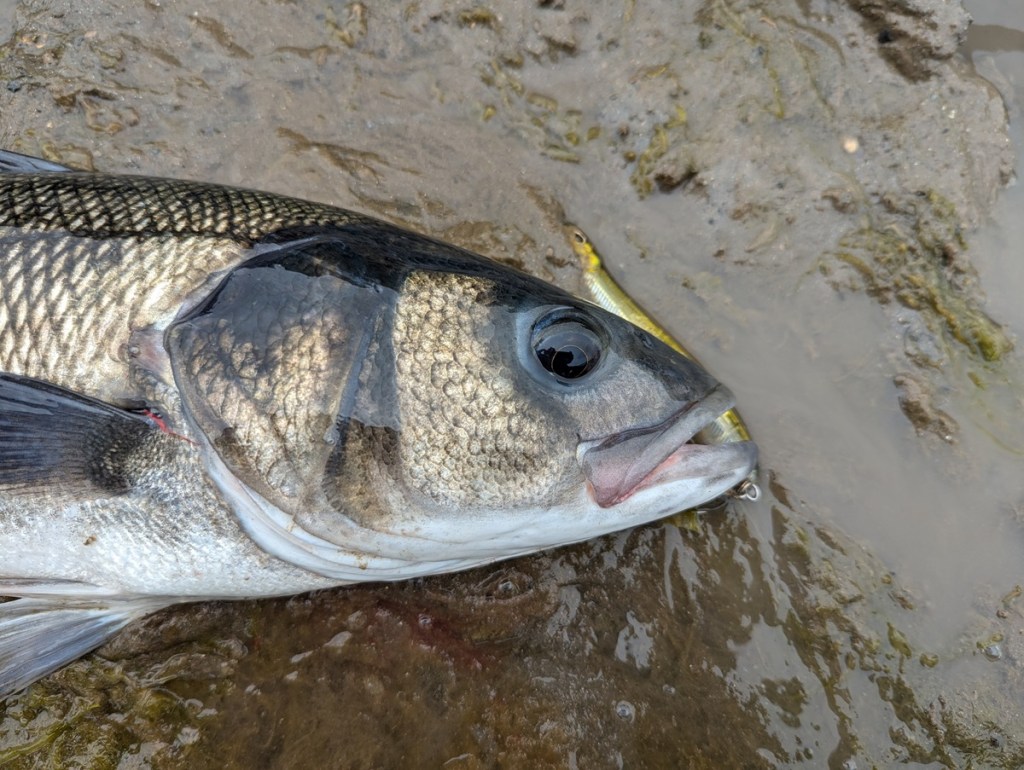
Well, just to quantify things as I did in an earlier post here, 70-80% of the bass that my clients and I land in daylight are tempted by the top waters – a staggeringly high number when you consider the variety of venues, environments and conditions in which I will attach them, and/or ask my clients to do so. However, ensuring that the lure is zigzagging, flicking, or swimming appropriately can be easier said than done when you add powerful tides, crosswinds, or choppy to fairly rough seas into the equation.
Rod up or down?
In addition to the above, if you’re new to lure fishing (and not just for bass), and perhaps you’ve been studying various videos of how to work a surface lure correctly, then you may be a little confused as to whether you should have the rod positioned up high, to the side, or down low. So, to place some clarity on the subject, very briefly, as a pro-guide I would advise you to do the following:
- In most cases, and especially when you’re stood above the water level, I would recommend holding the rod with as many fingers in front of the stem of the reel as possible, and with your index finger positioned along the side of the blank to enhance both ‘feel and control. Additionally, if you were a client of mine I would ask you to hold the rod slightly downwards and at 45o to your left (if you’re right-handed) and to the right (if you’re holding the rod in your left hand) so that you can rhythmically twitch your wrist/hand away from the lure – all whilst turning the reel’s handle of course.
- Alternatively, you could utilise the ‘rod up’ technique when you’re stood in the water (above knee-deep most certainly) – particularly when the lure is some distance away from you at the start of the retrieve, before slowly lowering the rod into the position described above as the lure gets closer to you, and you begin to lose that all-important ‘tension’ through the line.

Tight lines
Tension, through administering a tight line through the entire retrieve. This, in my opinion, is the most important element to ‘working’ a surface lure effectively, and it is something that can be difficult to achieve if the waves are moving the lure up and down, and/or the wind is blowing. And as such, it will require the angler to keep as much of the line in the water as safely as it is practicable to do so, by placing the rod lower and at more of an angle to the line and the lure also. Trust me, if you complete this function you’ll instantly sense more tension though to the lure.
And yes, this is precisely what I asked my client (Richard) to do, literally moments before the wonderful 63cm/6lb bass below and in the featured image struck – another personal best for one of my happy customers this season. “You absolute beauty!” These were the words we both shouted as we congratulated each other, and as his prize cruised away back into the depths.

Thanks for reading.
Marc Cowling
South Devon Bass Guide Ltd

 South Devon Bass Guide Ltd
Thanks Marc for a very special day for both Richard and myself.
Andrzej
LikeLike
Hi Marc. When I was with you last October I was having great difficulty in WTD. You got me to change to left handed reeling and showed me how to position my right hand on the rod correctly. At the time this was all quite alien after 60 years of angling right handed. Since then I have persevered and about 75% of my lure fishing this year has been on the surface, trying to maintain and even improve my technique. Over the time since last October I have wondered if I had remembered the instructions that you gave me and was I still doing it correctly. There is probably still room for improvement but the article you have just put up on your blog has given me confidence that I have got the action and technique pretty much right. A big improvement from last October thanks to you.
Roger Chandler
LikeLike
Thank you for the comments Roger. Well done for persevering and brilliant to read that the tutoring and the recent post have all helped.
See you again for the 3 Day Package
Marc
LikeLike