


My Year in Review 2023
(Client Catches)
Welcome to the first of my ‘Year in Review’ posts for 2023 – this one being a summary of the catches that my Clients achieved this year, with a further post detailing my Personal Catches to follow before the year is out – a bit of light reading you could say while this vile weather continues!
First of all, I would like to wish a belated yet ‘Merry Christmas’ and of course a very ‘Happy New Year’ to all my readers, followers, clients, friends and fellow anglers! I would also like to personally thank those clients who have made the journey from four corners of The UK, The Republic of Ireland (Barry S) and The Channel Islands (Dom E and Leo B) to be with me – your commitment was happily (for you and I) rewarded with some lovely bass I am pleased to report.
They say that the older you get the quicker the years seem to to pass by… Well, I can certainly say that my yearly reports seem to have come around exceedingly fast this time around! It has been another highly successful season on the guiding front, but also a rather ‘interesting’ one as you’ll gather not only from my anecdotal scribblings, but also from my thoughts and the short summaries interspersed between the catches depicted below.
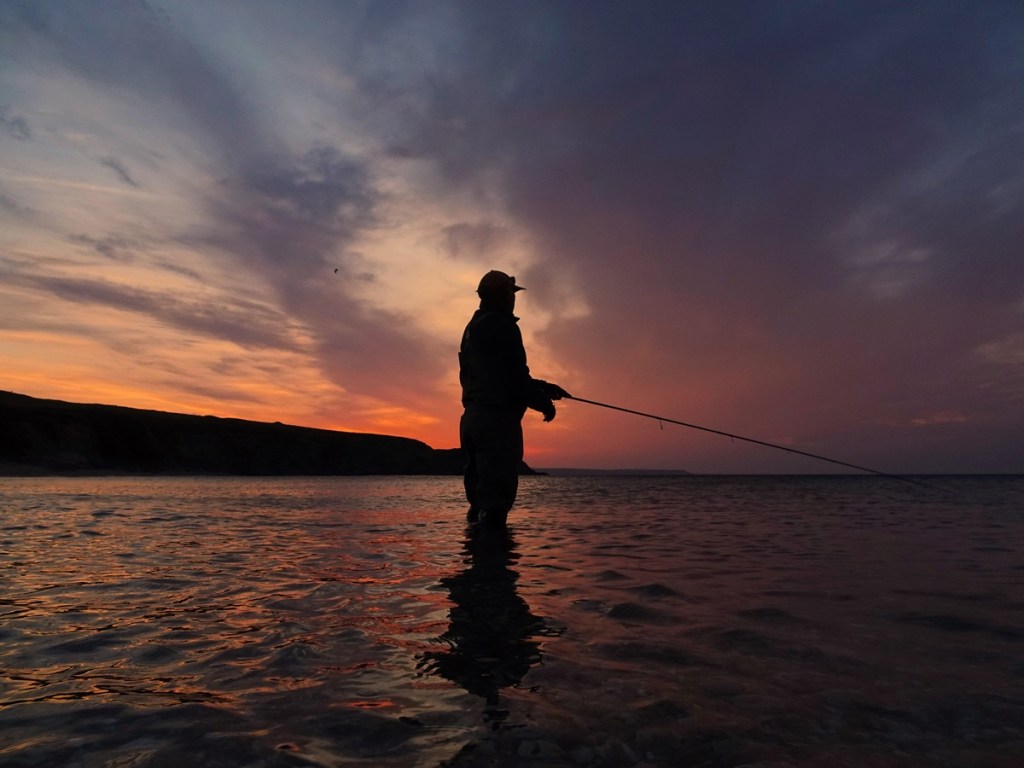
March
Off with a ‘Bang’
Once I’d decided that I was going to conduct my first guided session of the 2023 season in March (something I hadn’t done since 2017) it was with a high degree of confidence in our chances that I greeted my clients (Paul and his cousin Jason) for what transpired to be a session that set my season off with a real bang – quite literally in fact, although no rods were broken on this occasion…
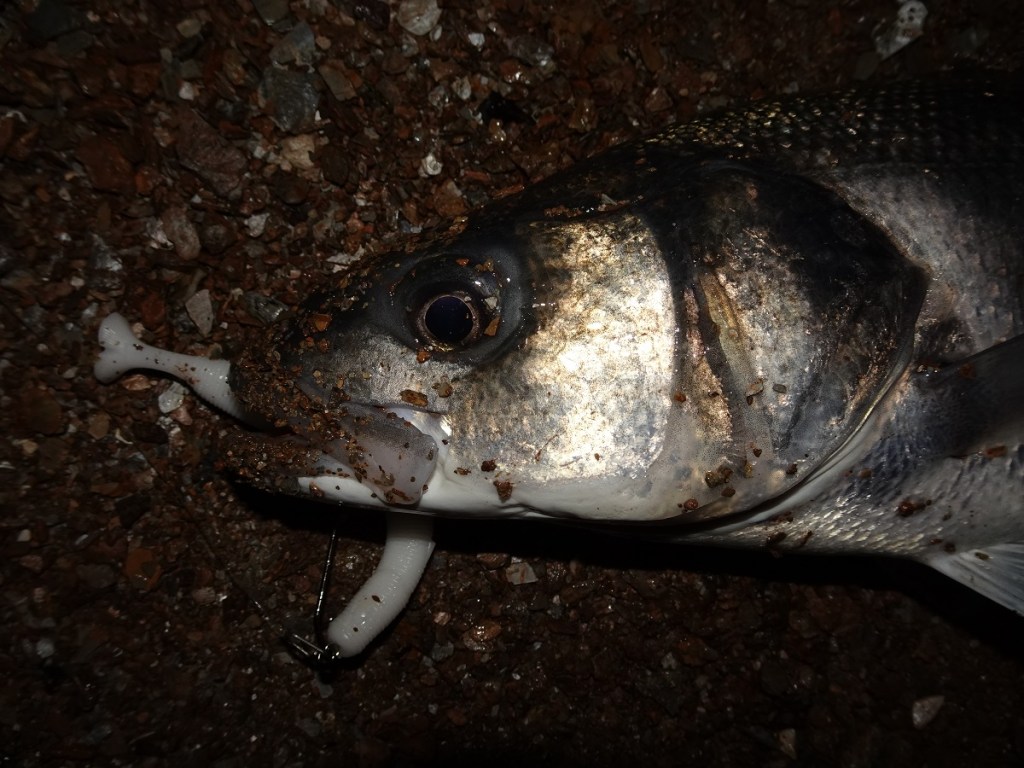
Yes, it was early in the season, however, as detailed within my social media posts at the time, alongside the blog post that I wrote in relation to my personal catches during the late-winter and early-spring period titled: One Lure – Many Moments, I knew that there were bass already inshore and ‘up for it’. Indeed, having landed a lovely plump four pounder whilst fishing with Henry Gilbey only a few days prior to this session in late-March, armed with his new-found skillset, Paul (below) manged to extract two bass of 54cm and 57cm respectively.
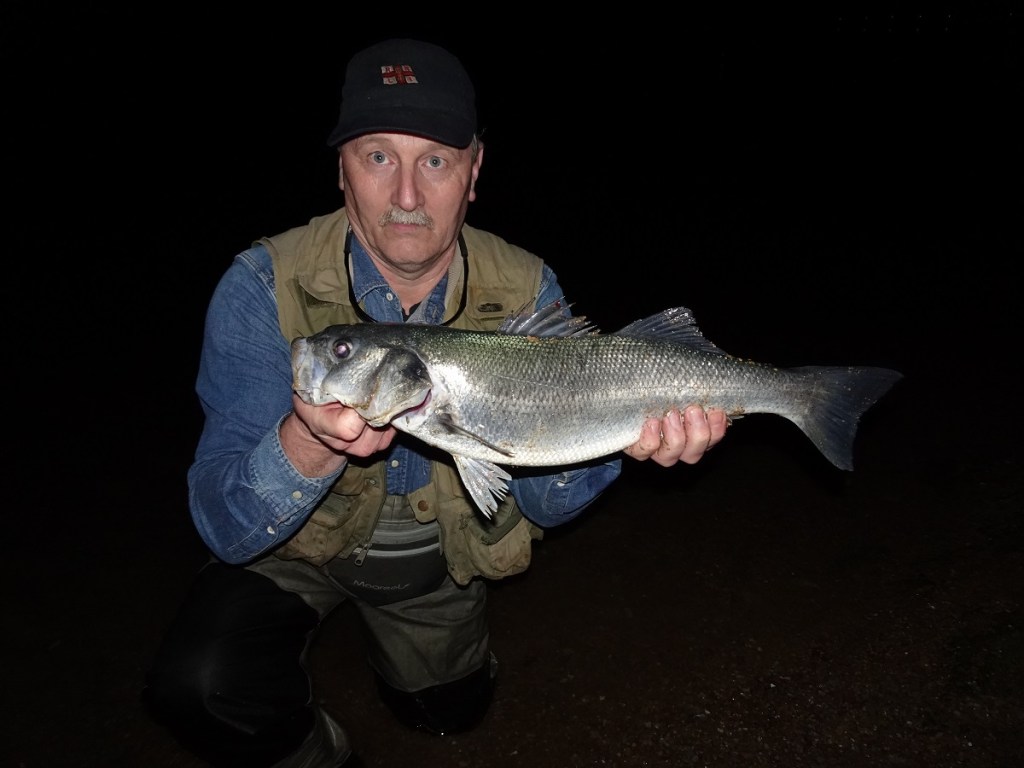
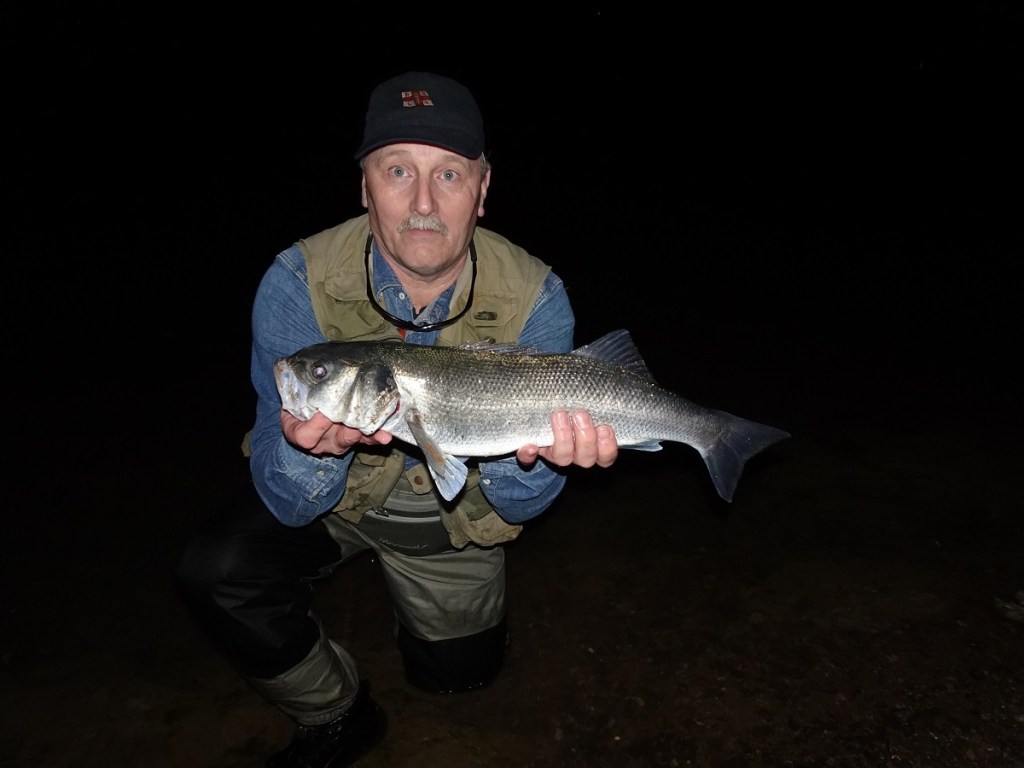
Clearly, it wasn’t at all cold during what was a magical March evening out on the south Devon shingle (we’d pay for that during the subsequent weeks!), and it was especially satisfying to be in a position to assist two thoroughly nice chaps to catch (and release) some lovely early-season bass via the use of a very, very specific technique and the use of a lure (the 13g, 120mm Savage Gear Gravity Stick Pulse Tail) rigged in an equally specific manner.
You can read the full story of Paul’s catches within the post that I wrote titled: ‘Client Catches – Absolute Affirmation‘. Furthermore, if my reference to an exceedingly singular method has piqued your interest and you aren’t already in the loop from reading the intricate and intriguing details within my most recent book, then you can find it all within the ‘Marginal Gains chapter of said title: Bass Lure Fishing – A Guide’s Perspective (Volume 2).
April
Season on the back-burner…
In 2022, from mid-March onwards until the early-April we’d experienced some fantastically settled and sunny weather – all of which encouraged the sand smelt numbers to explode within my local estuaries in particular. But fast forward 12 months and the scene was very different, as the favourable, albeit brief window that had assisted me and us during the latter days of March had, in essence, been a curt respite from what was a pretty awful run of weather. I was ducking and diving continually!
Cold, very wet, or very windy, or at least two of these delightful elements on every single day and night had persisted since early-March, and there wasn’t any respite in sight even into mid-April and beyond. My clients were learning and catching, but certainly in comparison to the previous April the fishing was, on the whole, very slow. Indeed, it almost seemed as if Mother Nature was winding the clock backwards, with frosts arriving during the final week of April – which is pretty rare here in The South Hams.

But despite the adversity, as the sea and air temperatures grudgingly increased, so did the regularity to the bass catches, as well as the overall average size. Moreover, it was the open coast beach/reef venues (rather than the estuary mouths where I/we have enjoyed success at this time of the year) that began to yield the better-sized bass first of all. As expected in the conditions we encountered throughout April, the bass were exceptionally localised which prompted me to write the first of a Three Part Series titled: Client Catches – Particularly Precise (Part 1 of 3).

The way I see it though, the tougher the conditions or the thinner the bass are on the ground, the more I have to work to find them, and in turn, the ‘better’ I will become as a guide. I still write everything down following a session, and prioritise this (as I always have) over washing down my gear I am a little ashamed to admit. You see, nowadays, I genuinely learn more from the ‘not so good sessions’ on ‘my marks’ than I do from the red-letter days. To elaborate, we wouldn’t be there if I didn’t expect to catch, although I have to report that the majority of my early-season ‘banker’ venues were decidedly ‘off form’ as even into May, the overall airmass remained chilly to say the least.
May
The irony and the easterlies!
Only weeks after releasing a blog post titled ‘My Recent Catches – Is March the new May?’ (in which I highlighted what I believe are the ‘forerunners’ to the bass season arriving here in south Devon around the second set of spring tides in March), it somewhat ironically took until the customary ‘period when they arrive’ during the second set of spring tides in May for the season to finally kick off!

In truth, I was still wearing a woolly hat when fishing and guiding in darkness up until the second week of May such was the continued colder than average airmass – and even though the Sun did begin to blaze from a clear blue sky, it was forever tempered by that nagging easterly that seems to develop in the spring down here.

In the back of my mind at this juncture, was that in seasons gone by, if a heatwave were to occur, then the sea temperature and consequently, the bass’s metabolic rate can be transformed within a matter of days. Unfortunately this wasn’t the case, and rather, as per April, there was just a steady increase in the numbers and the size right across the board in terms of the wonderfully diverse locations in which I am fortunate to fish and guide upon.

I considered the fishing was now ‘good’, although I/we were still having to work exceptionally hard, and harder than I expected given the numbers of bass that were seemingly present two to three months earlier in the year… A case of ‘transitory fish only’ perhaps – following the sand eel and mackerel shoals…?

Based on how many days (between 270-300) that I spend fishing myself and guiding my clients (you’ll recall that I do not fish when I am guiding) over a calendar year, one of the few patterns of behaviour that endures year on year, is that any bass present during the coldest months (January, February, March) tend to feed harder in darkness. Then, as things begin to warm up and their urge to feed rises exponentially, they begin to ‘show themselves’ more and more in all manner of daytime conditions.

The larger specimens most certainly appear to adhere to this comportment when the sea is hovering between 9-10oC, when the 50-60cm bass will also follow suit it seems. My theory here is that the bass prefer, quite simply, to exert more energy when their prey (especially crabs and smelt) are more active at night. Then, as the sea temperature rises, and the sand eel shoals appear inshore (not just sporadically but in huge, if often localised numbers), so the daytime fishing in the generally clearer and calmer water becomes more consistent.
June
‘Bouncing…’ But where’s the bait fish?
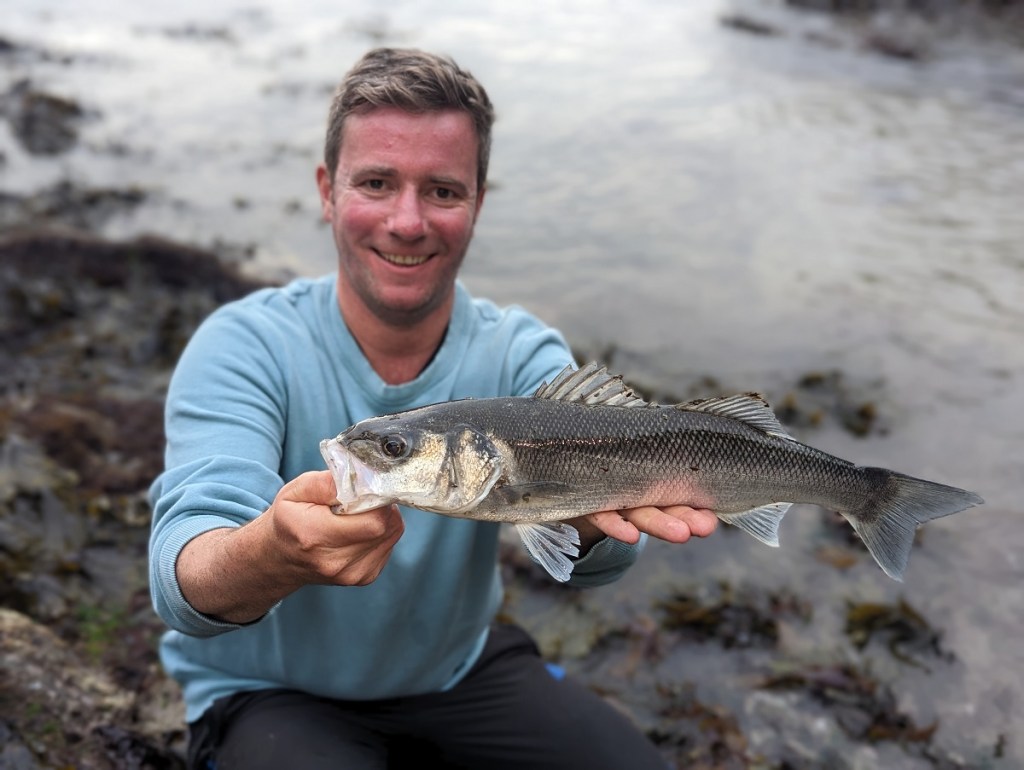
‘Bouncing’ between sections of this spectacularly varied coastline is something I am required to do each spring, in order to build a picture of how the overall season may progress. And as is often the case come June (summer), a significant number of facets to the bass’s behaviour were already beginning to materialise. To affirm this, I wrote about each important integrant within the first of another Three Part Series (namely the Client Catches – Summer Synopsis Part 1 of 3).

That the surface lures (notably the Patchinko 100, 125 and 140) were ‘king’ didn’t surprise me, as once the bass are effectively looking ‘up’ and the water is warm enough to entice them to attack the movement from above this, again, is a routine trait of these irrepressible hunters. No, it was the lack of small (2lb or less) bass swimming around my local coastline and within the more brackish settings that was surprising me.

As intimated earlier in this post, it was very sunny from mid-May and well into late-June, but throughout the entire period the drawback was that the wind was literally ‘howling’ in from the east. Now, although I don’t prescribe to the notion that “when the wind is in the east, the fish bite the least” it most definitely kept me ‘penned in’ in regards to mark selection and tactics…

At the end of day of course, my job is locate and catch bass before releasing them as expeditiously as I/we possibly can. Added to this and as also mentioned above, my attitude is that I will always continue to learn if and when the cards that I am delt in relation to the weather are less than favourable – so it is a win/win situation in essence. What was less than ideal however, was that when I added into the equation that if we caught or did well from a specific venue, and then I returned within 24-72 hours, the bass just were not there, or they did not want to play. They were certainly keeping me on my toes!

Things were getting ‘tricky’ as they say, and I was beginning to exhaust my extensive portfolio of ‘east and north-easterly marks! But in the end, I think even the bass thought ‘Sod this, we’re going to feed regardless’ which, as a subsequence, resulted in some really memorable sessions around the middle of June.

What’s more, as you’ll be able to ascertain from the images enclosing these paragraphs, the bass were being landed from an impressively diverse set of locations, ranging from the shallowest, muddiest inland creeks, to the wildest, sandy and shingle beaches, ricks and over reefs, and also the most remote and deepest (in terms of water depth) headlands and tide races. Part 2 of my Client Catches – Summer Synopsis blog post covers this subject in greater detail if you fancy a read.

Providing a staggering insight into their ‘effectiveness’ in conjunction with their effectual use, the Patchinko 125 accounted for almost 90% of the bass landed in daylight during June – all of which culminated in writing Part 3 to the Summer Synopsis series towards the end of the month. Alongside the confirmation that our tactics were ‘spot on’, it also offers a clear indication of what the bass were feeding on – or rather hoping to feed upon in my view as I really wasn’t witnessing anything remotely indicative of bait balls, or prey items being slayed on the surface.
July
Subconsciously sub-surface
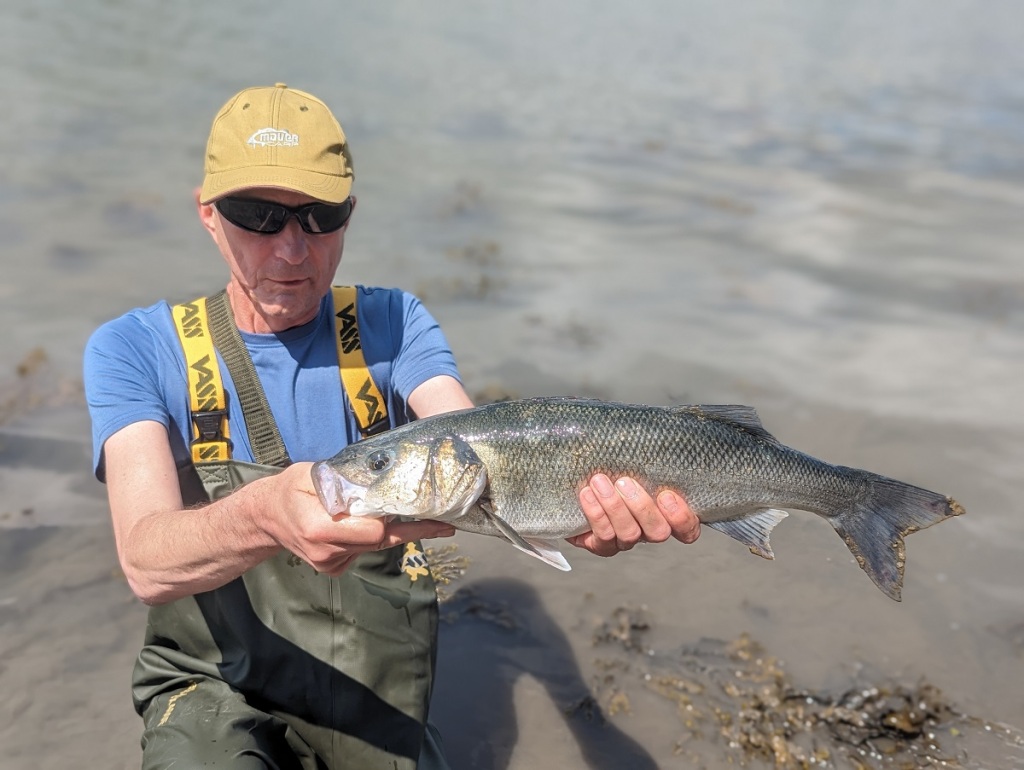
If you haven’t already picked up on the general theme to my client-based yearly review just yet, then I will spell it out: it was very, very ‘weather driven’ in the sense that four months into my season, ‘mark selection criteria’ was very much based on what the wind was doing… Tides, I genuinely have the marks at my disposal (through a great deal of time and effort) that will ‘fish’ over the smallest of neaps, and the largest of springs, and everything in between.
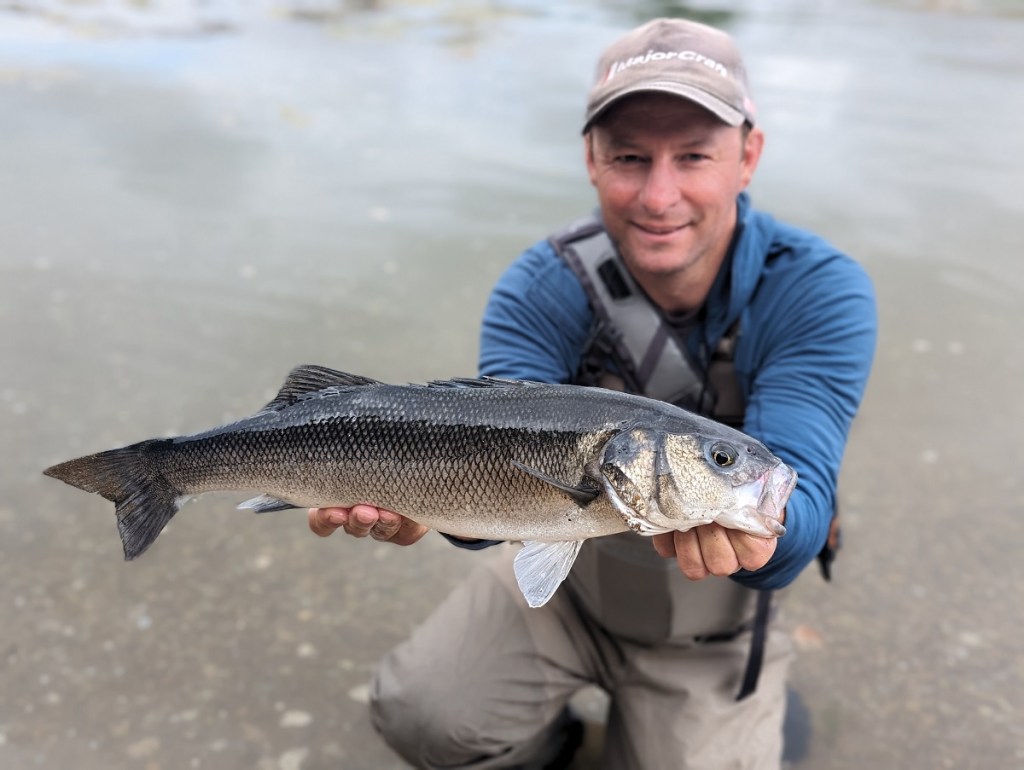
In reality then, it was the sea state, water clarity and density to the weed fragments remaining after the continuous ‘blows’ that I initially considered, and that ultimately influenced my decision making over everything else over the entire summer. The choice was relatively simple: do I embrace the wind by fishing venues exposed to onshore conditions within rougher seas (over shallow reefs, sandy and shingle beaches) or do I look to shelter from the wind’s effects, via fishing in the lee of the land, or within the numerous estuarine systems that surround me.
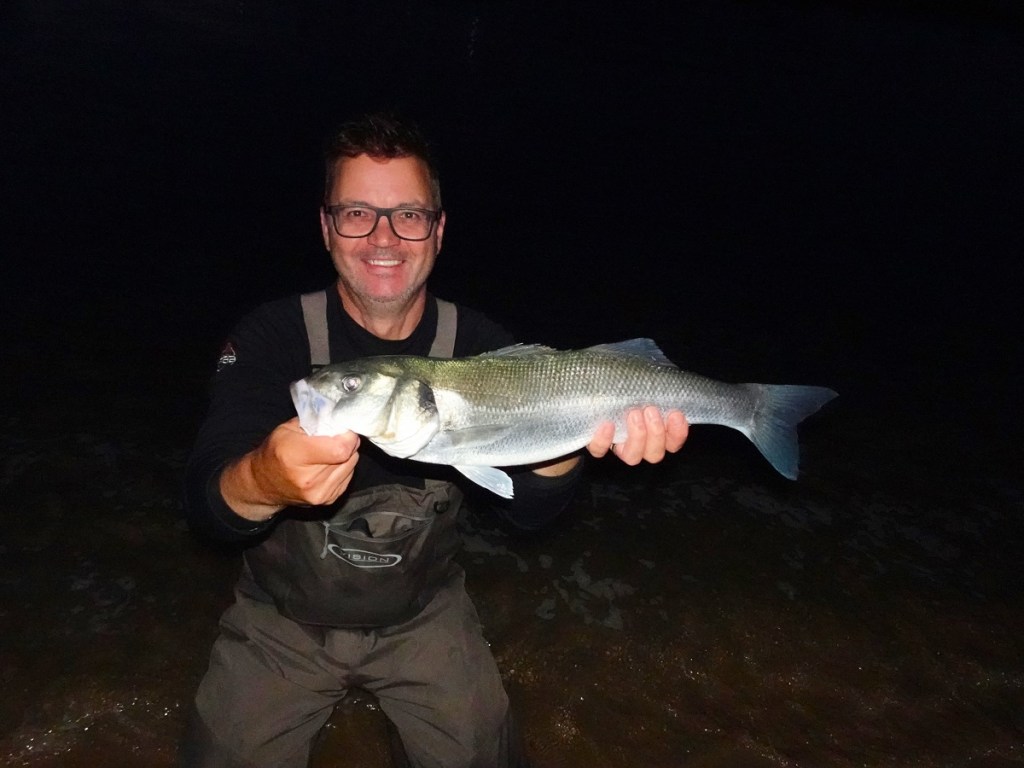
With my more ‘midway up the estuary venues’ just not firing in any shape or form due, I believe, the lack of any smelt, sand eel, early white bait/sprat and even crabs being present within them, I decided to concentrate my/our efforts on the steeply shelving beaches of south Devon, both by day and by night for a little while…

My rationale behind this was threefold. First of all, I knew that the sprat and mackerel invasion was imminent (they did in fact arrive in earnest on the evening of the 11th July) and that it would be these deep water venues that would see them being herded up the shingle long before they began to infiltrate the estuaries. Next, due to the lack of reef and wrack in these areas, I reasoned that they would be less likely to be ‘weeded out’, plus they would be far safer venues to fish from than the my rock marks, that were suffering from the immutable swell and legacy weed situation(s).

Finally, the third motive was that even if there was a bit of a sea ‘running’, the steepness to many of these beaches meant that the angler (my clients and I) would remain standing well above the danger zone, with losing a few bass in the powerful backwash having to be accepted as a consequence.

But where potentially powerful waves and a strong undertow are encountered, you either need to fish with jig-heads or heavily weighted weedless hooks (when using the soft plastics), or even better, ‘recommence’ attaching the hard diving minnows that many of us utilise less and less nowadays I guess…? I have to thank my friend and regular client Jud here, as he decided to take a ‘punt’ on using an IMA Sasuke 95 I think it was during a session and on a mark that I wouldn’t have ordinarily thought they would be effective.
I don’t mind admitting one bit that he was right and I was wrong, as he landed three bass in quick succession during what had been a quiet evening up until then. My suspicion was that the famed ‘search image’ of the bass had shifted from ‘wanting’ something substantial (the Patch 125 or 140) splashing on the surface, to a comparatively small (at 80-100mm) item retrieved quickly under the surface – sprat like…

Gradually, session by session, throughout the latter stages of July and into August (when the weather was still unsettled overall and utterly appalling at times) the sub-surface hard lures – you know, the one’s with a vane or lip on the front, became a staple in our armoury.
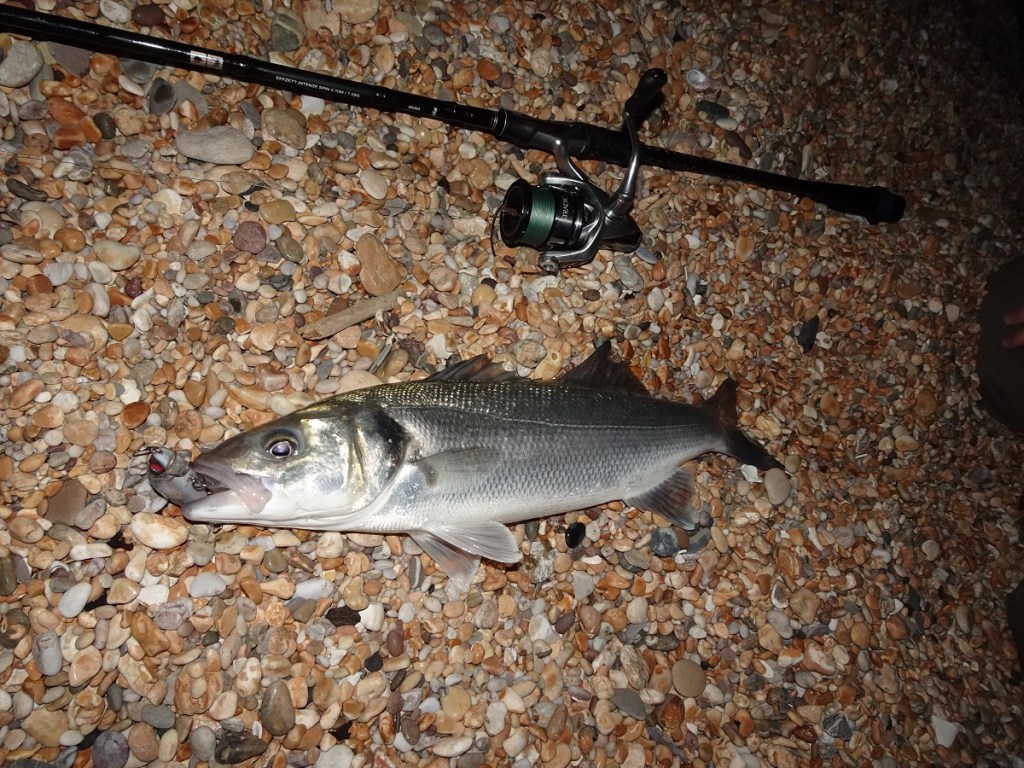
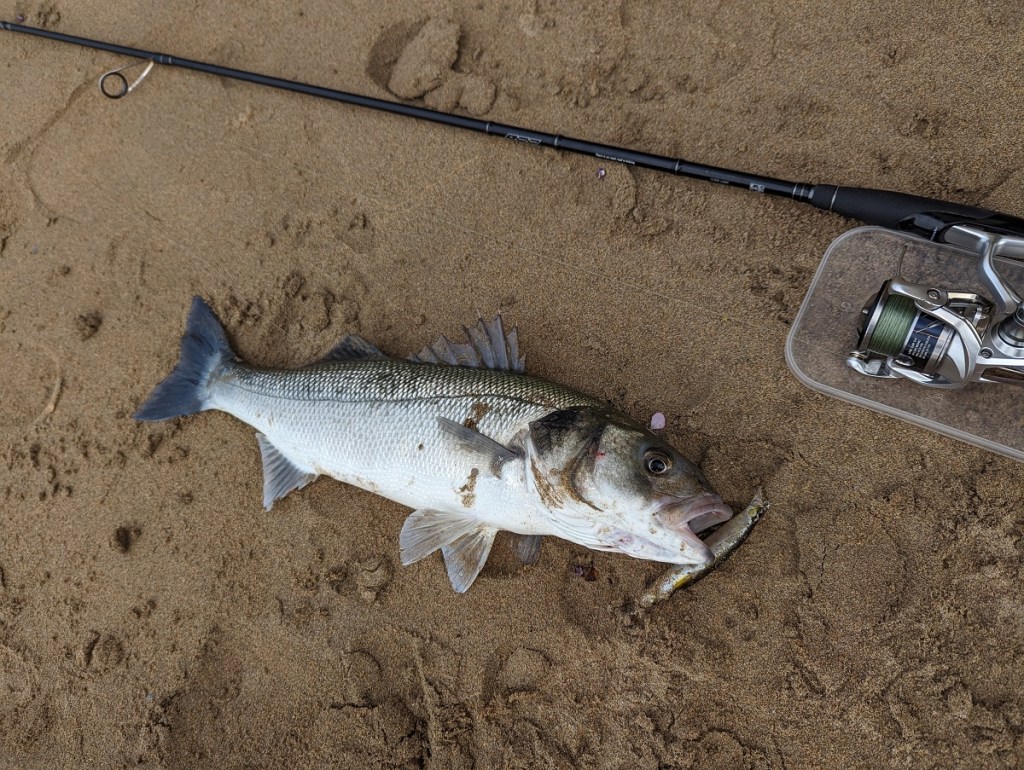

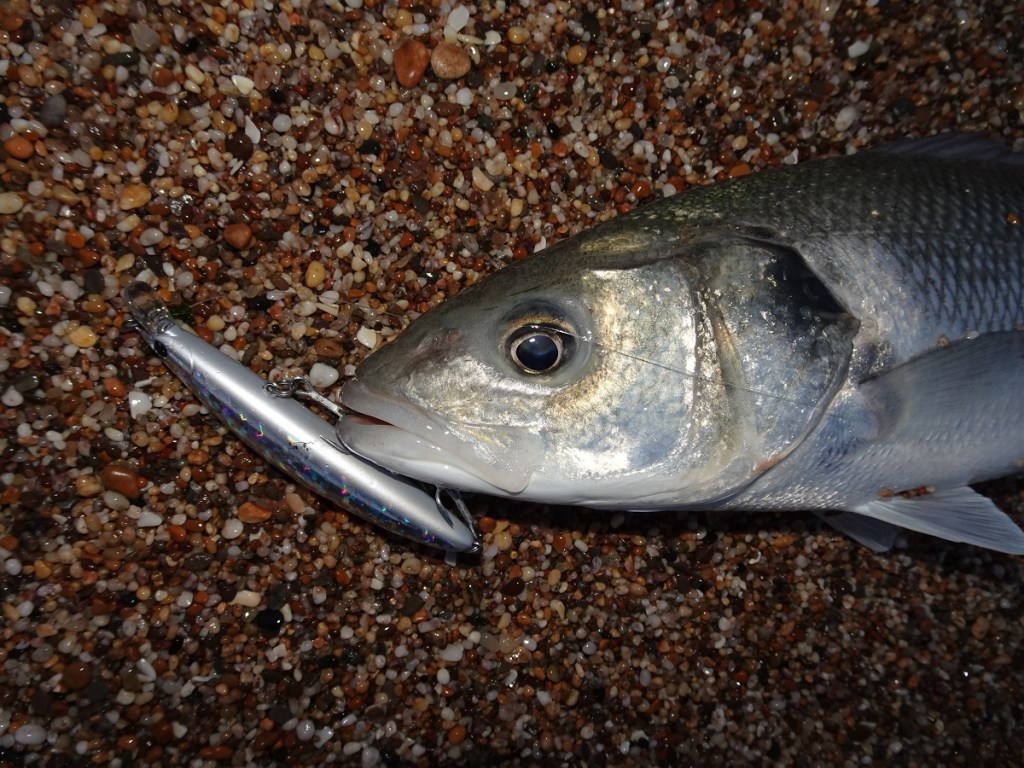
IMA Lures lead the way in this field in my opinion, with the Hound Sonic 100F, Hound Glide 125F, and Sasuke 95, 105 and 120 Goriki consistently a cut above. My blog post: ‘Client Catches – The Constant Classic‘ describes what are my favourite hard, diving minnows, as well as how, where and when we utilised them to great affect.
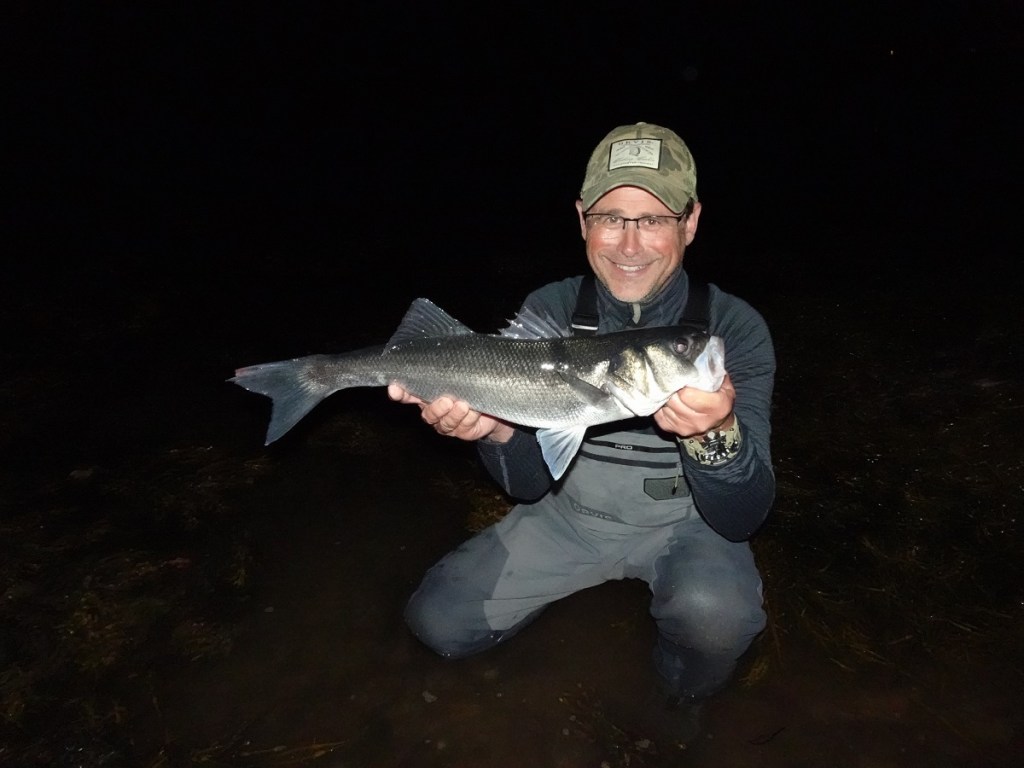
For all the talk above about lure fishing for bass from rugged shores and often remote coves within some fairly turbulent sea conditions, it was during my final guided sessions before I embarked on a long-overdue family holiday in late-July (a period that marked the halfway stage of my guiding season) that one of the most intriguing captures occurred…
I named the blog post ‘Client Catches – The Sound‘ because without the bass above making itself known via a rapid BADOOOOOM at a range of three metres from our legs we’d have been completely unaware of its presence. The guile and outright disdain for mine and Aaron’s nattering, as we stood together in the weedy margins as he lobbed the 120mm Gravity Stick out for the 500th time that night, was gobsmacking to say the least.
OK, the 5lb bass in the photograph above was duped into taking a delicately flicked lure into its vicinity, but the fact that it had the confidence and audacity to slink in to have a feed almost under our feet is something you’ve just got to have respect for! Another thing that I say it every year is that these amazing fish never cease to amaze me…
August
Normal service resumed…?
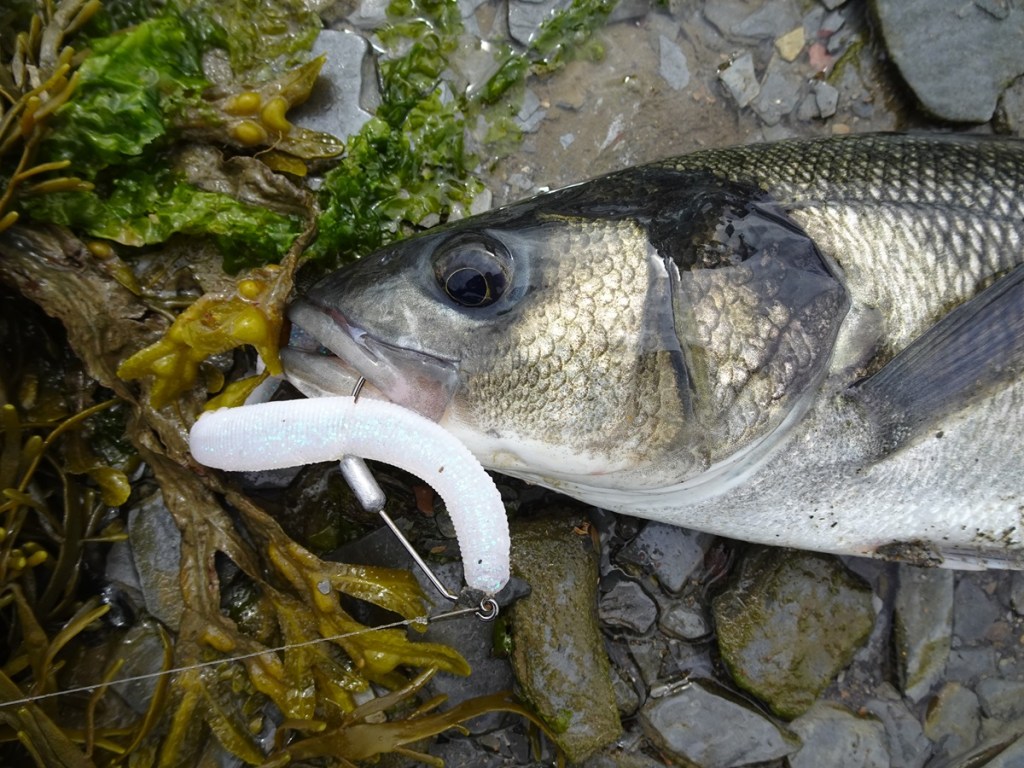
I’d been away from my guiding operation for a fortnight when I welcomed my 3 Day Package party (James, Mark and Pete) to south Devon. Therefore, I don’t mind admitting to a little bit of apprehensive due primarily to fact that I hadn’t had my finger on the ‘bass pulse’ as it were… My concerns were very quickly banished however when Pete was nailed by the biggest bass of his personal season (below) achieved on the unbelievably consistent Gravity Stick on another favourite colour configuration of mine (White Holographic from the Hi-Viz packs).

From the same Hi Viz pack (containing the vibrant Lemon Back pattern) his fellow client James (below) added a further quality bass as the water shallowed and the wind increased to produce the expected turbid sea conditions.
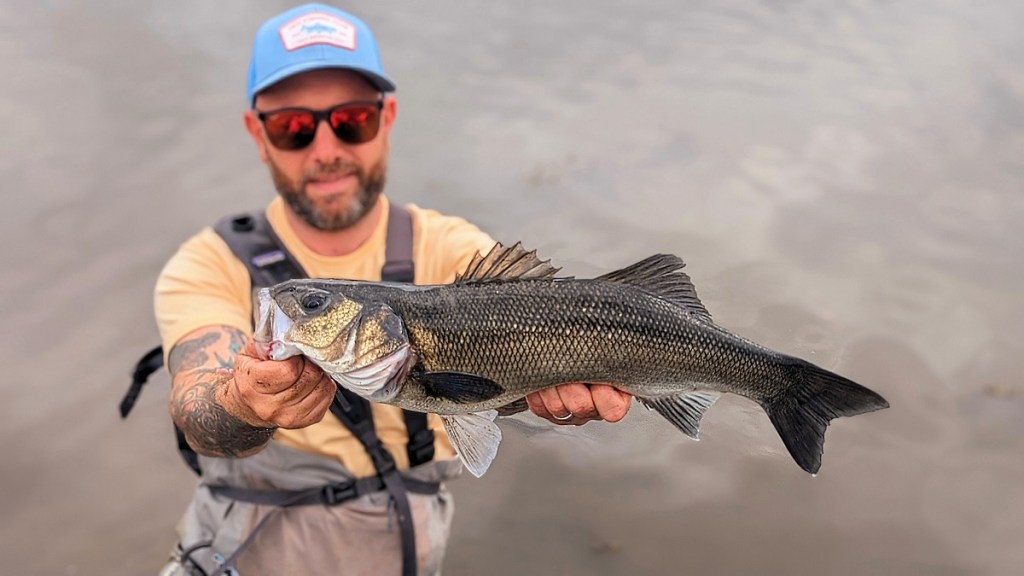
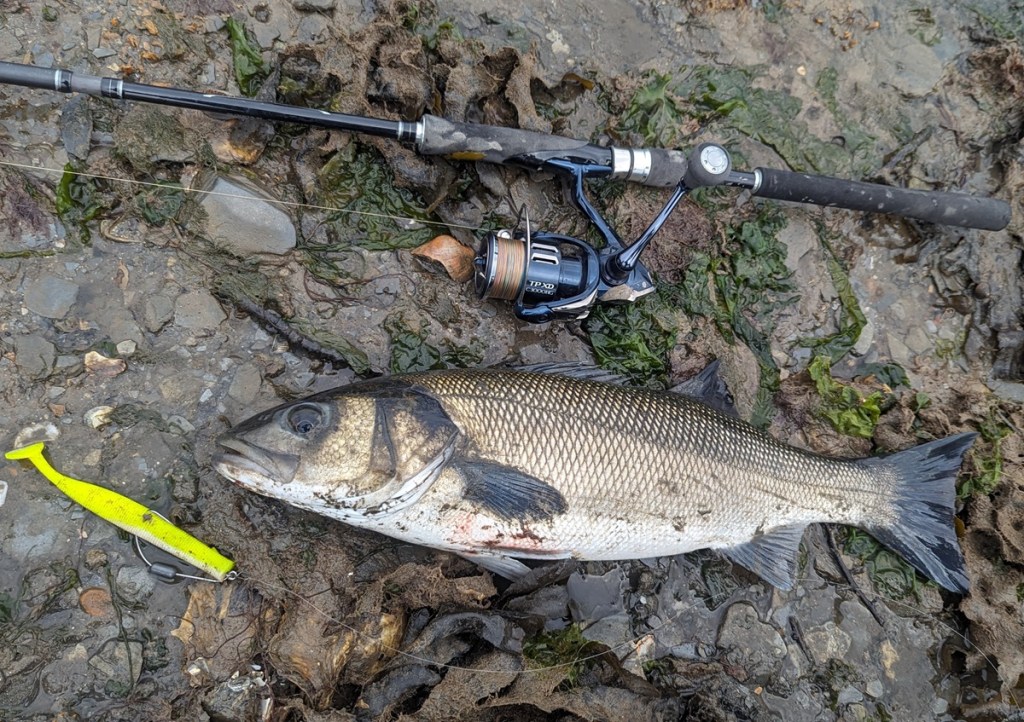
I highlight these two catches, not because the bass were especially big, but because they effectively set the tone for the second half of season within the estuarine environments that I frequent. They were noteworthy and I was slightly relieved – as this was that this was the first time in 2023 that I actually located bass in anything resembling feeding mood in brackish water and on specific marks that have would have ordinarily have produced dozens of bass, and some ‘good-uns’ to boot, by this stage of the season.
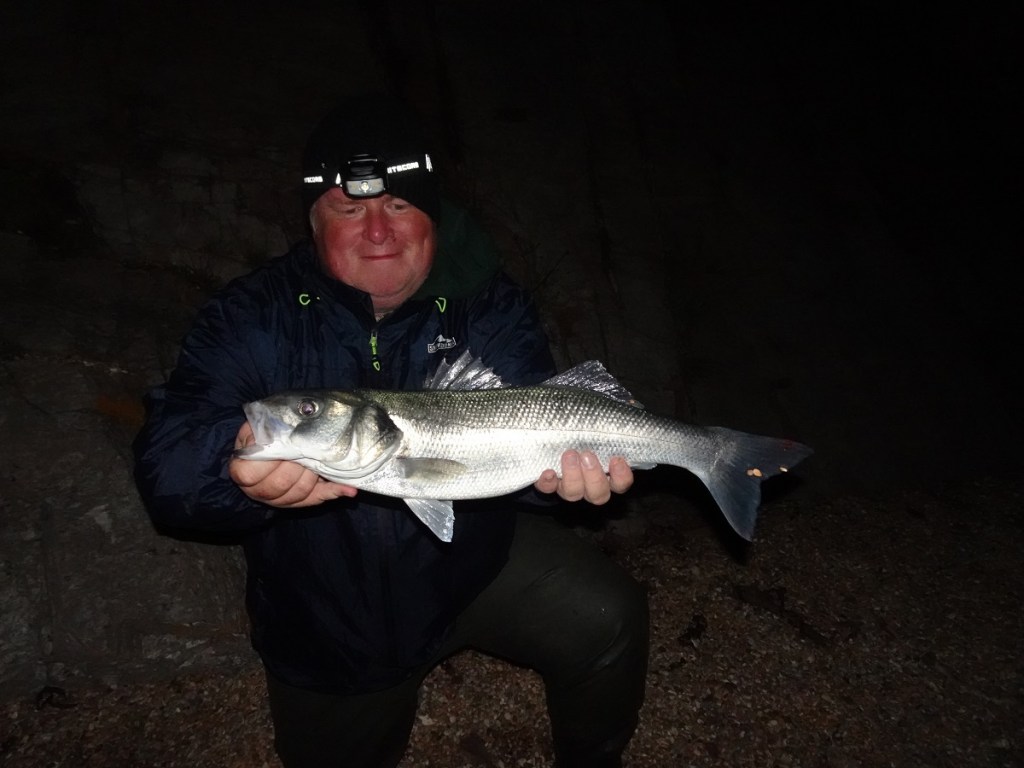
So was ‘normal service’ was about to resume I wondered…? Well, with the estuaries seemingly beginning to produce when and where they should be, in addition to the bass ‘biting’ in darkness over a variety of terrain types – all in conjunction with the evenings beginning to draw in, I had high hopes. The only drawback(s) at this stage of the season was that the sea temperature was nearing its zenith, and the sprat/whitebait were pretty sporadic (courtesy of the continued unsettled weather) meaning that the bait fish and bass were there one day and gone the next…
‘The Rob Hillman Collection 2023’
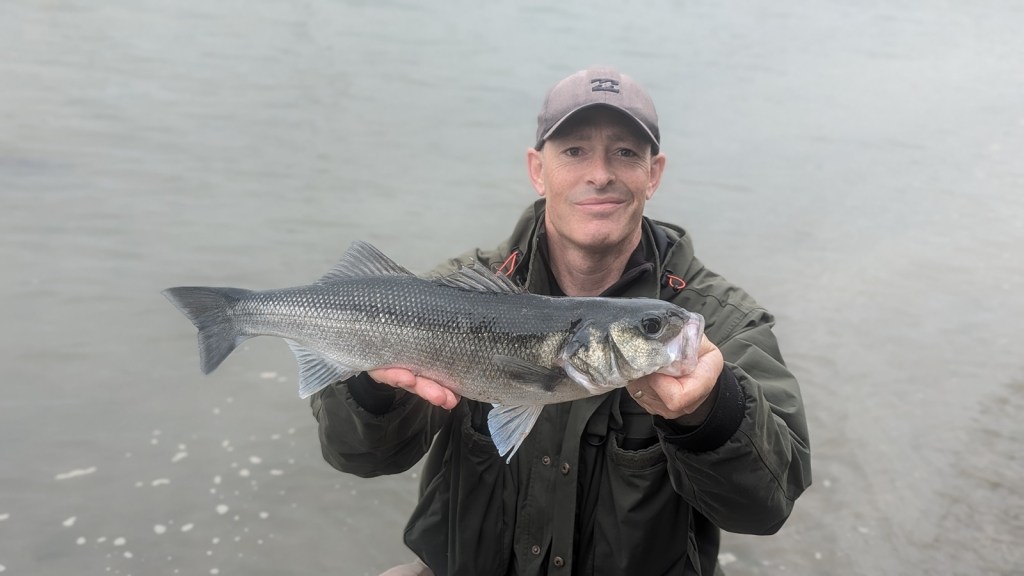
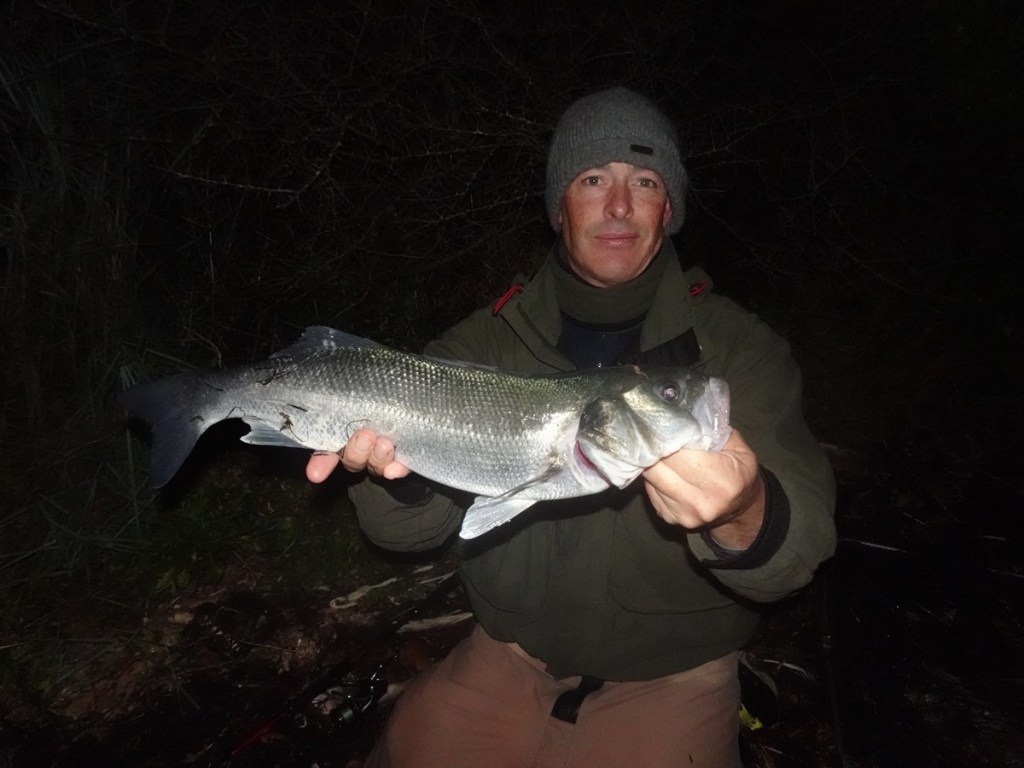
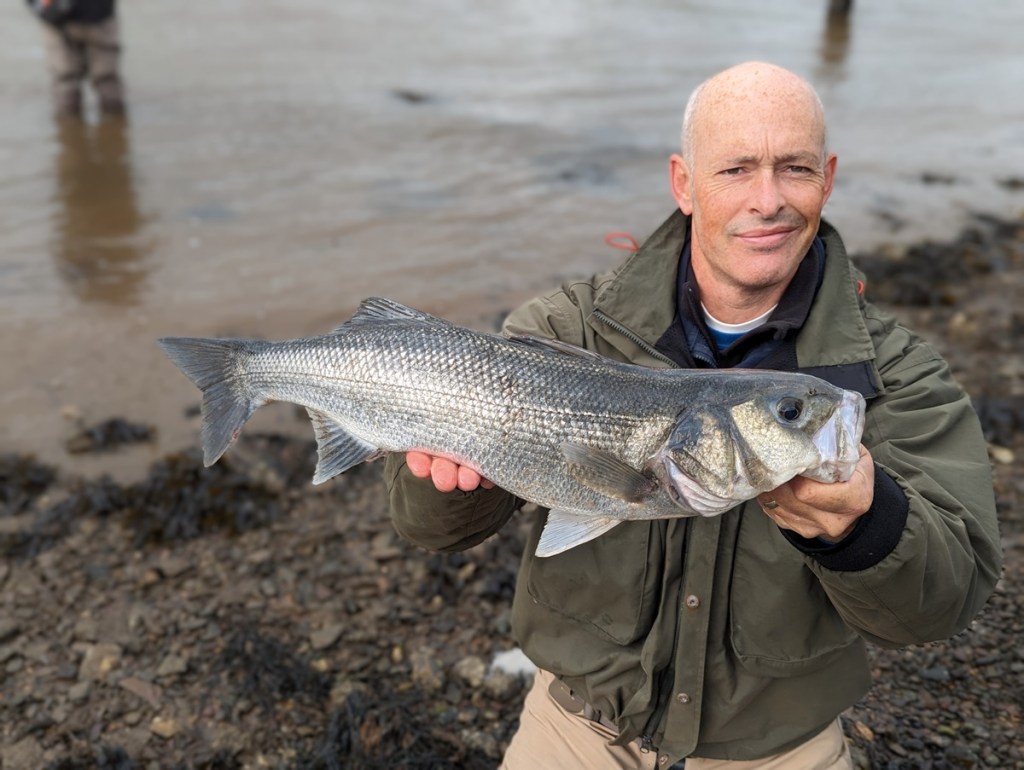
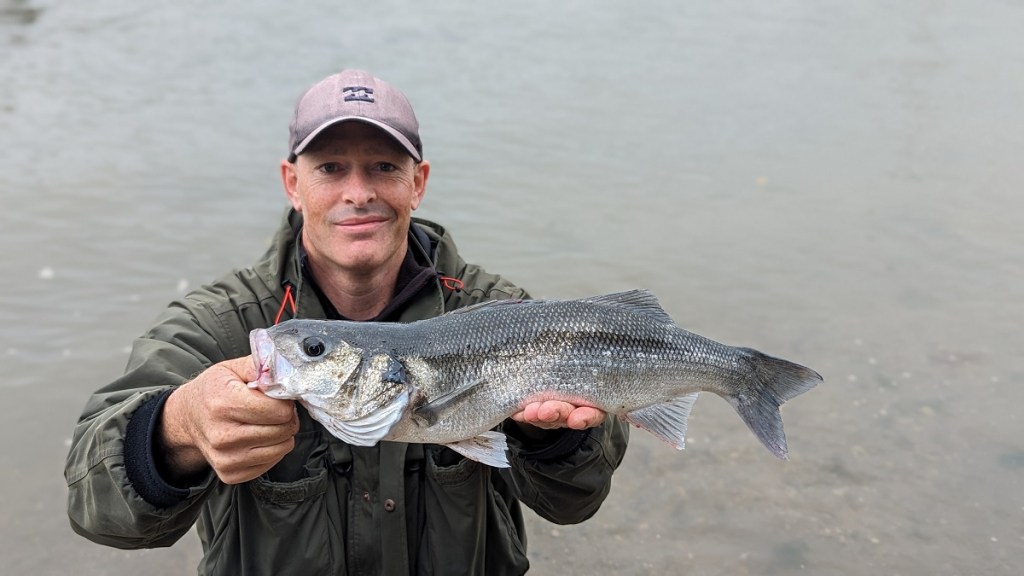
If you follow my/our experiences on social media (I tend to post the catches up on Facebook first as it’s the quickest and easiest media to spread the news bar Instagram (which I am considering using regularly in 2024) then you could not have failed to notice that a chap called Rob has featured rather heavily in 2023! I have permission to pull his leg a little here (as I did with a similar client called Andrew a couple of years ago) with a collection of catches that I considered ordering as a ‘2024 Calendar’ for him and his family!
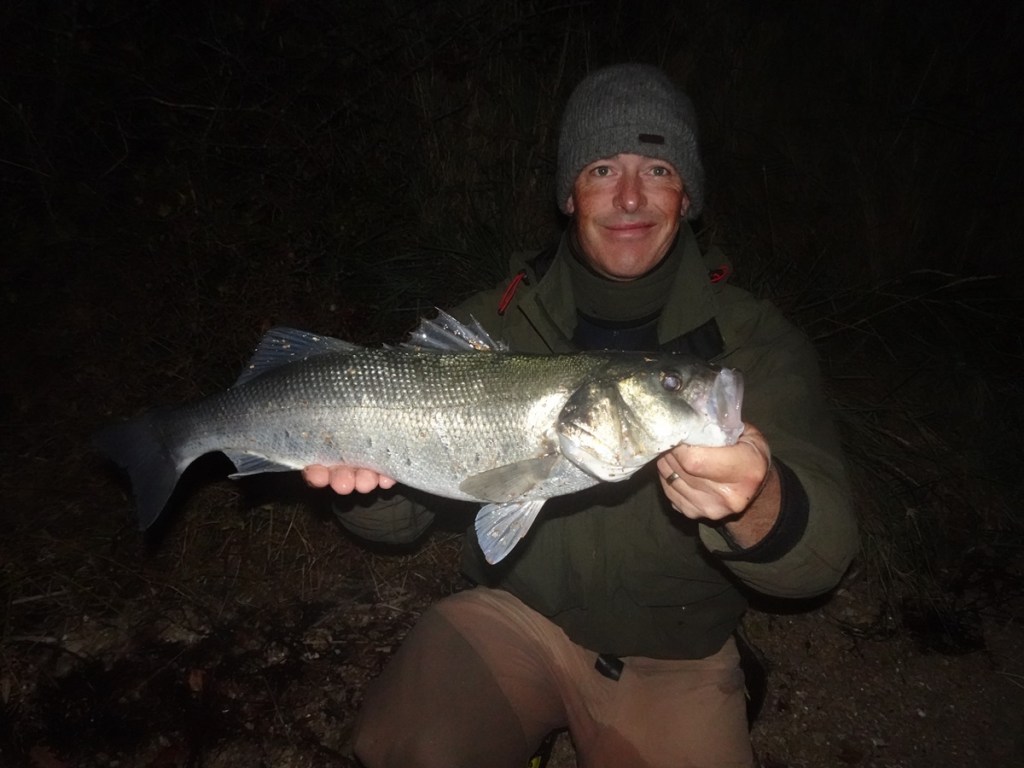
Rob landed some brilliant bass with me this season as per the images below, (you may also recognise him from the ‘A Guide’s Perspective Volume 2 from the ‘Hunter’s Moon story), but initially, he was really struggling to gain any real confidence in the use of surface lures, or when lure fishing with paddle tails within very murky water prior to this season’s glittering array of catches.
But as you can see from the images below, I’m sure you’ll agree that he absolutely smashed any reticence and reluctance completely out of the park, as all of the 2023 bass below were caught (and released) via these two deadly methods, in addition to utilising a Savage Gear Gravity Stick Pulse Tail in darkness – which was another lure type he had wanted to get to grips with.


The Chase…
As I have alluded to a couple of times already, if my 3 Day Package clients had said to me “Marc, please can we go back to where we were yesterday” (which they did of course!) because they’d enjoyed a great session, it was highly likely that the bass just wouldn’t be there. As a professional guide this can clearer be a frustrating, but with often contrasting wind, sea, clarity and weather conditions almost on a daily basis anyway, it really was a case of heading to the places where I reasoned there was a greater chance, over being highly expectant every single time I ventured out.
Find the bait fish, which was a mixture of sand eel and sprat/white bait in some pretty ‘random regions. it has to be said, and we would find mackerel and then bass – easier said than done of course on such a vast coastline. Also, In addition to this, a further feature of the catches was that although I never again observed only bass taking their prey off the top after the early-June dusk beach event, when shoals of fry were visibly being swept by the current, strangely, only a surface lure would entice the bass into taking…
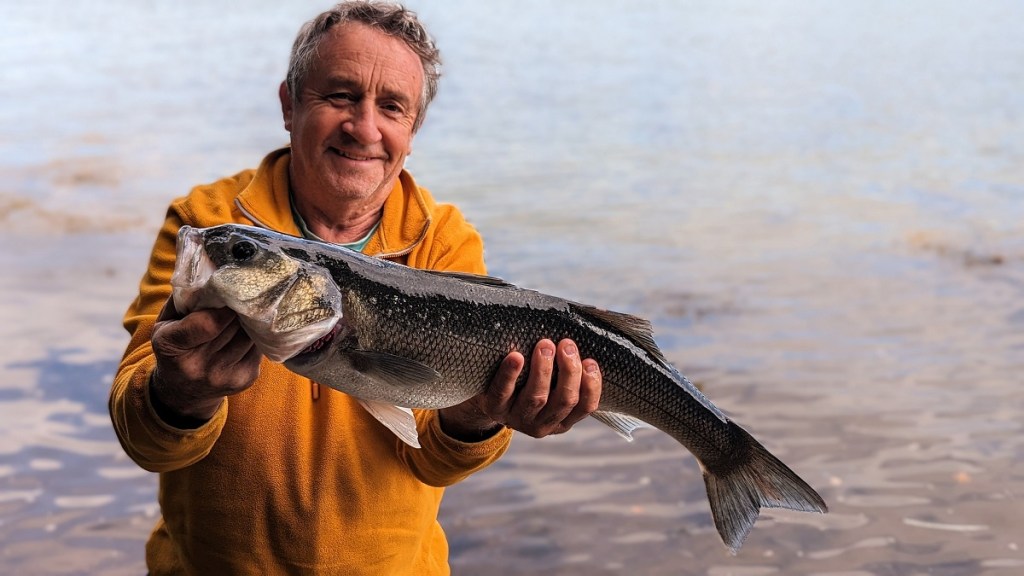
I really was enjoying ‘the chase’ I must say, and I’ve being doing this long enough now to be able to comprehend two constituents in particular when dealing with what is a very a wild creature: a) that the season always tends to ‘average itself out’ and b) that a ‘fish of a lifetime’ or a PB at least is always just around the corner.
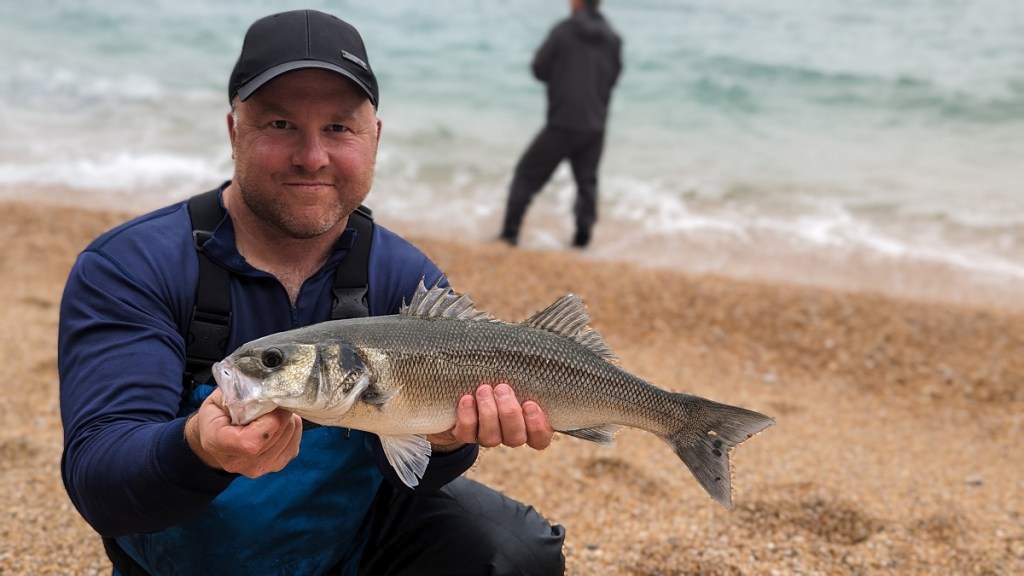
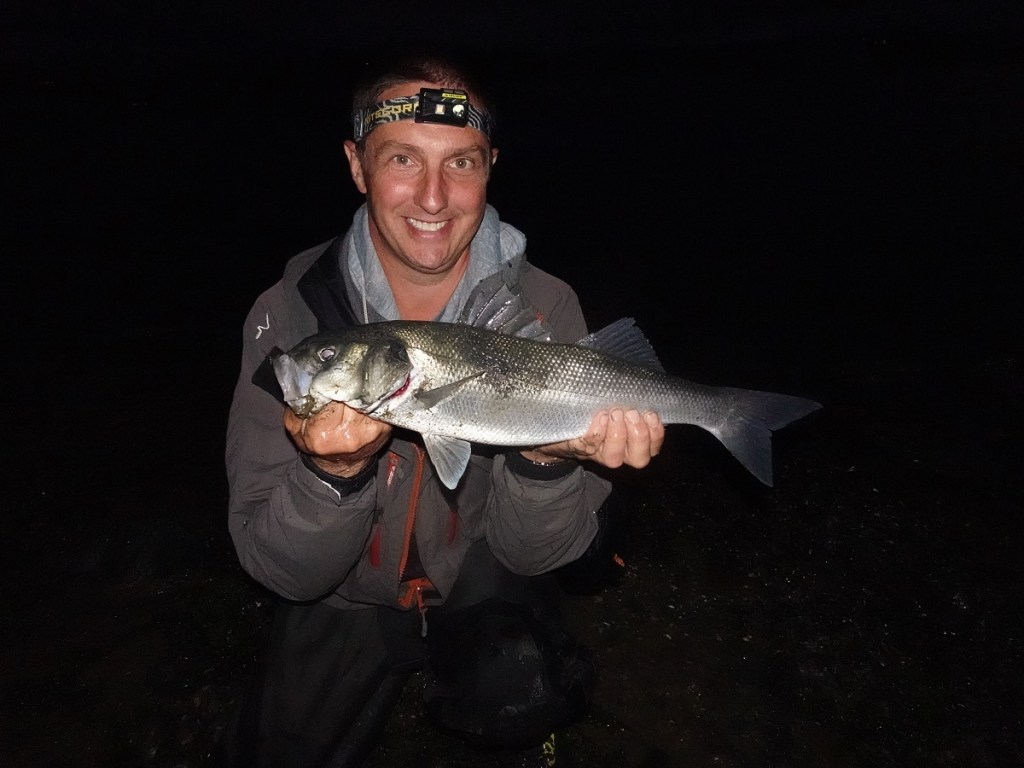
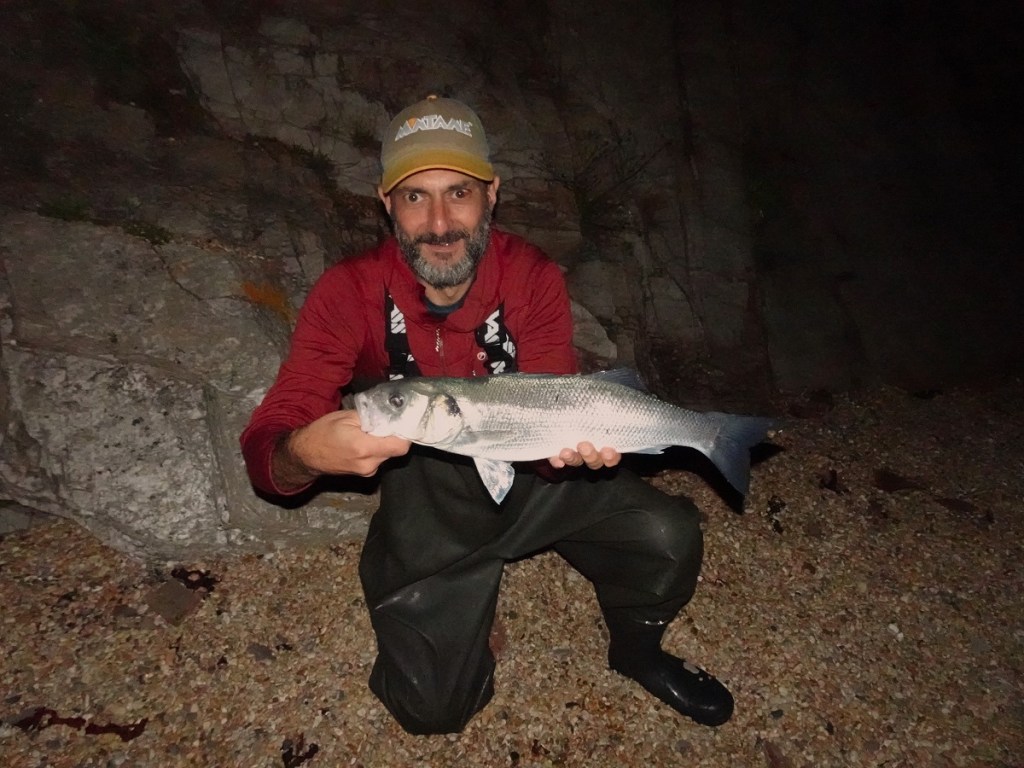
What’s more, because I was having to scrutinise all of the parameters and components involved in selecting the right marks for the conditions, we found ourselves fishing and catching bass from a diverse series of venues, periods in the day, different lure types and sections of the tide. Indeed, I hope the slideshow of the more significant catches in August below provides an suitable insight during what was a period I thoroughly enjoyed having had a mid-season break.


September
A hot streak
If I was pinned down and asked what my favourite month is in regards to bass lure fishing I would have to say September… or maybe November… See, I still can’t commit! For a variety reasons, I always take the first 10 days of September off from the guiding, and I might only venture out a couple of times myself during this juncture even though everything is in place during early-September. The water is warm, the natural food items are abundant, the days become shorter, and we usually experience at least a fortnight of beautiful weather which, to my surprise, did indeed occur!


Again, looking back through my notes and diary entries, there are periods in every season when the bass (and mullet) seemingly disappear, yet to almost ‘balance out’ these intervals, there are also phases in each year when every single time I/we head out fishing we latch into a good one, or two, or three, within the same session. So, once I was properly ‘back in the game’ around mid-month, my client above (Dave) enjoyed one such afternoon in which he smashed his PB twice with bass of 55cm and 62cm respectively. You can read about these captures in my blog post here: ‘Client Catches – The Concentration Cog‘.

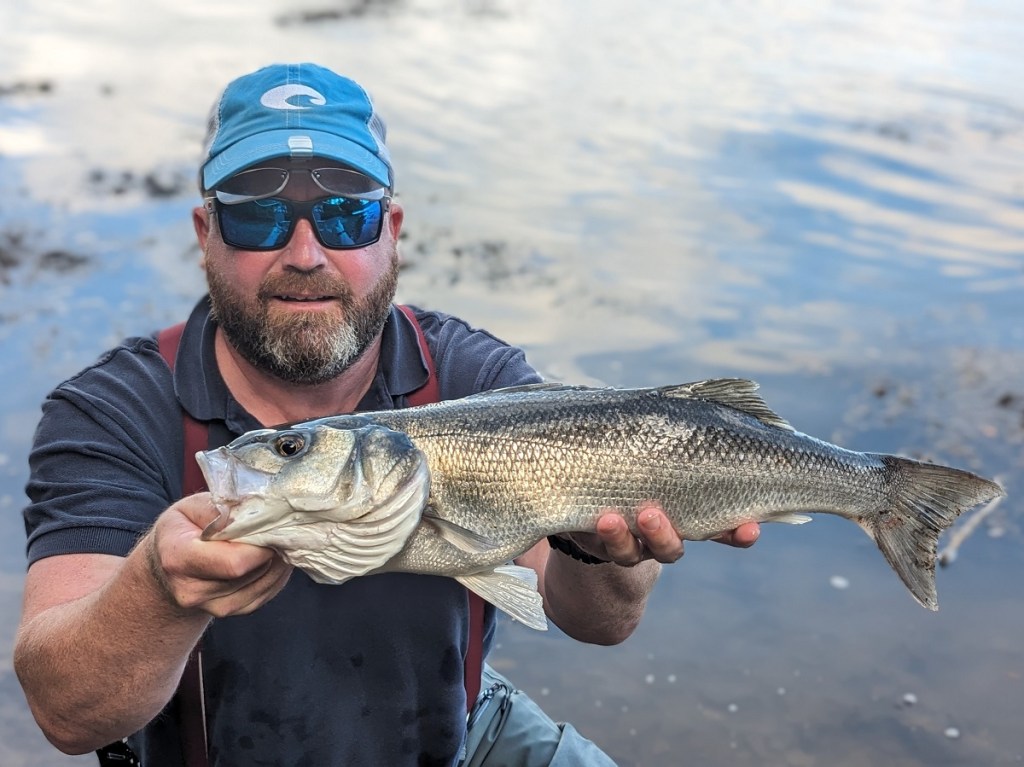

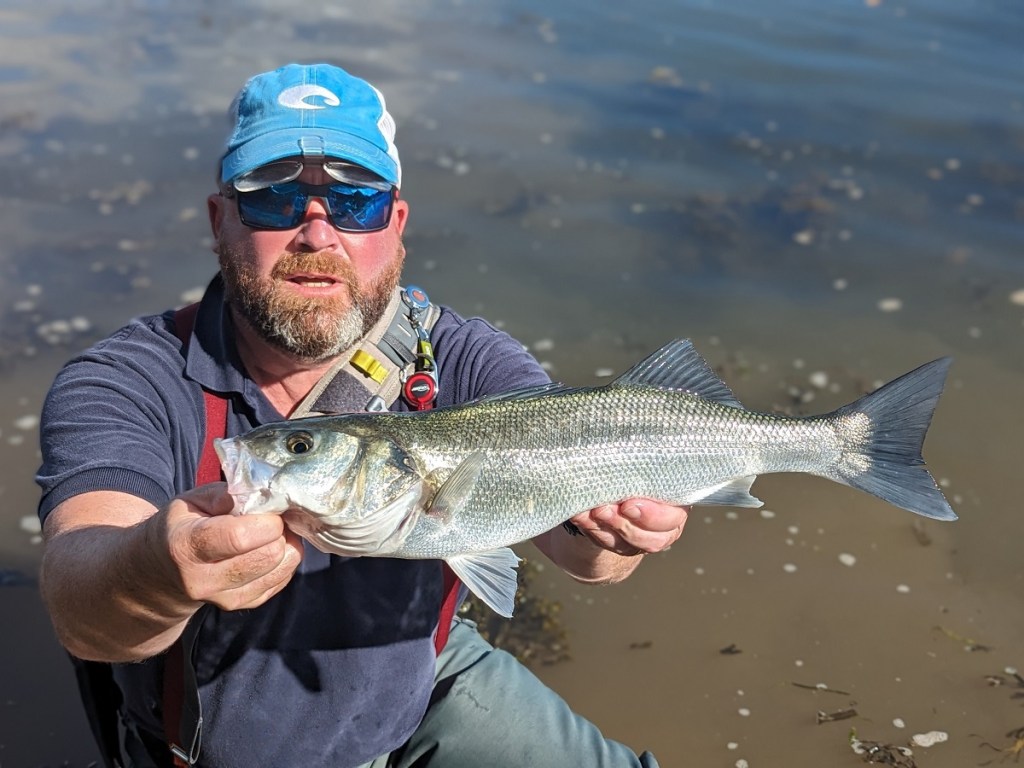


Only a couple of days prior to Dave’s PB beating endeavours, my client above (Paul) was so pleased with his impressive haul of bass (2x 60cm fish, in addition to 3x over 50cm in three casts would you believe) that he proclaimed it as ‘the best‘ fishing he had ever experienced which, considering he has ‘Game Fished’ all over the World was high praise indeed. What’s more, he landed all of the bass in the slideshow above on a cheap surface sliding lure called a Yokozuna/Ryoshi Shibasu 105 (here). Again, you can read more about these captures, and others from around that chapter of the season on what I would term as ‘cheap or imitations’ (copies) of some of the more popular lures out there. The post was titled: ‘Client Catches – The Real McCoys…?‘

As you would have no doubt of noticed from the backgrounds of these memorable September sessions, the more brackish settings were beginning to really fire. And while the water was relatively clear-to-very clear, once again, if there were any bait fish in attendance (they didn’t need to be harassed as already covered) the surface lures would rule which was the case for my happy client above (Alex) who travelled all the way down from London Town and straight back again to be with me. Respect.
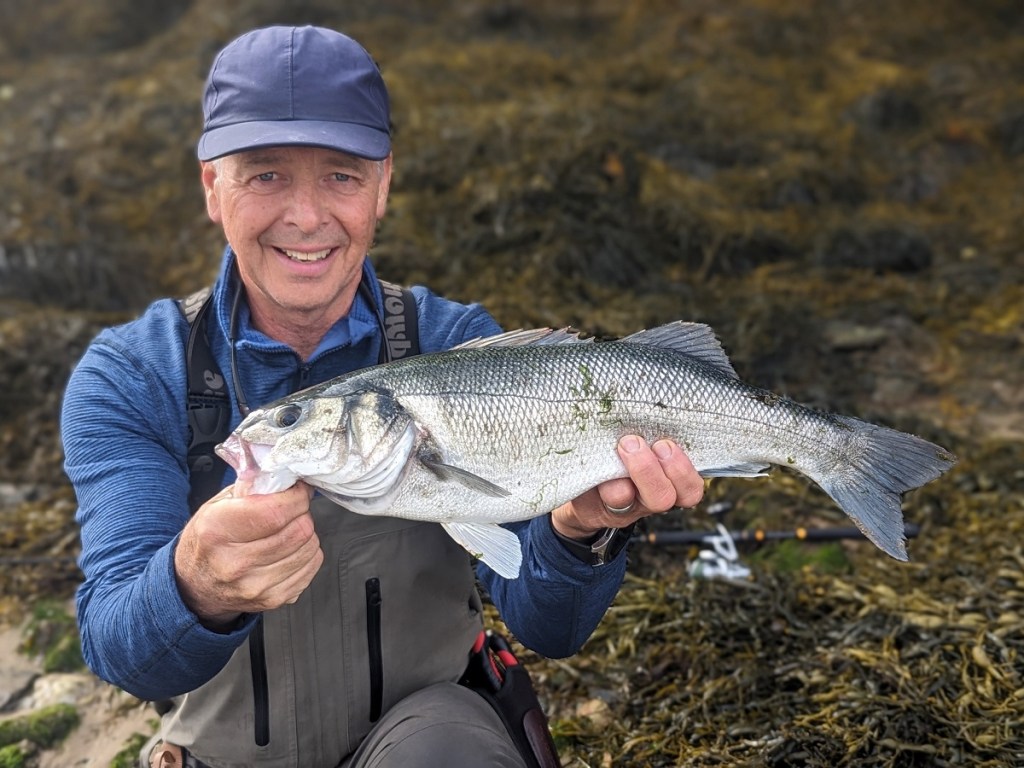
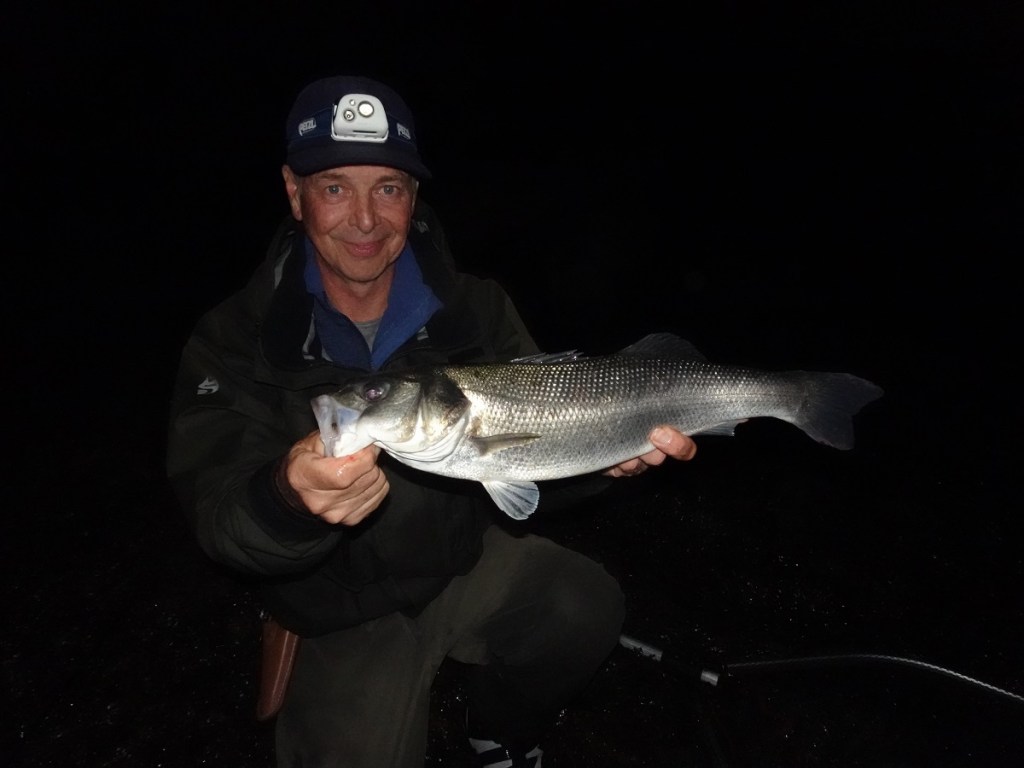
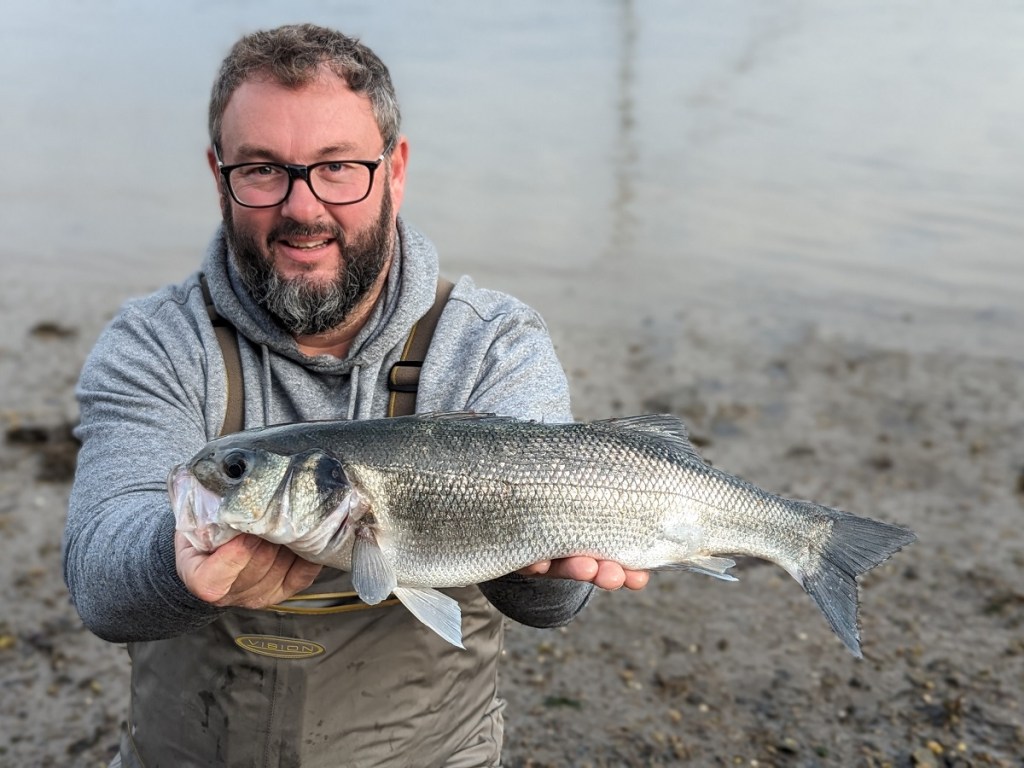

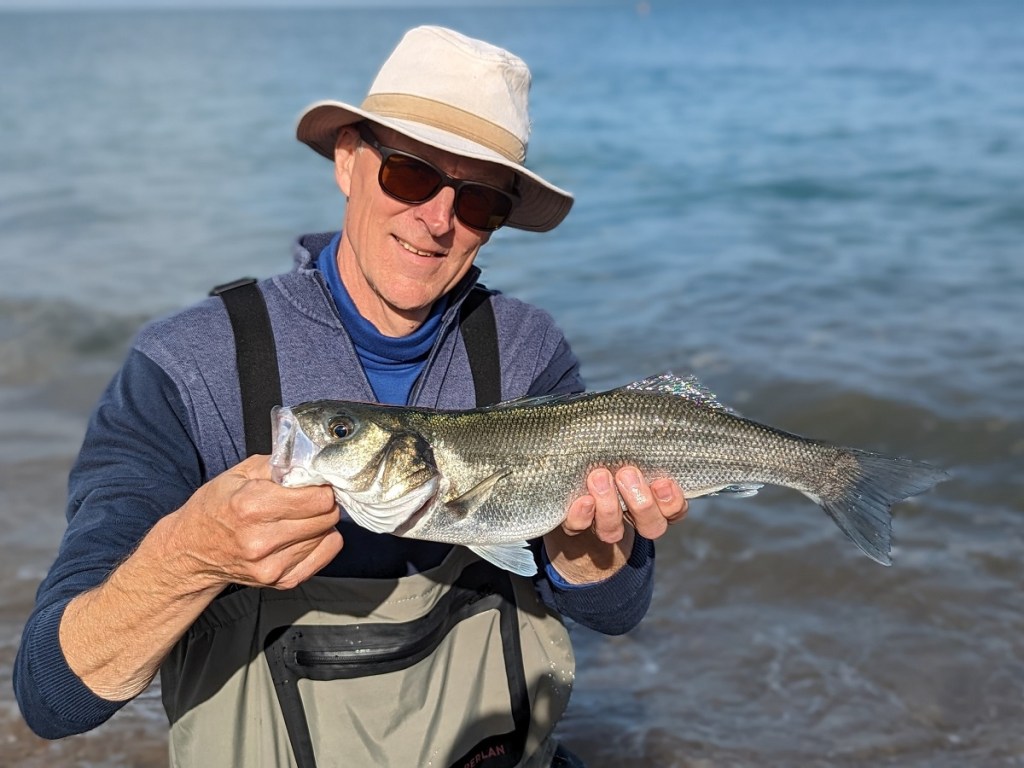
So one other final facet as to why I really enjoy fishing and guiding in September is that all of the different types of venues I guide upon are highly likely to produce bass within what I would have determined to be the prerequisite conditions. With that in mind, the slideshow above highlights the client captures, in September, from beaches, rocks/reefs and the inner estuaries in both daylight and darkness.
October
Paddle Tail Time
Invariably, as the frequency to the wet and windy days began to increase moving from late-September and into early-October, so to did our incursions into the more sheltered territories encompassed within the estuarine regions. In general, where salt water meets fresh there will always be an element of turbidness to the water clarity, but when you add torrential rain and Gale Force winds into the equation, even if we can manage to tuck ourselves out of the worst of it all (which I can do incidentally), the remnants will still need to circumnavigated.


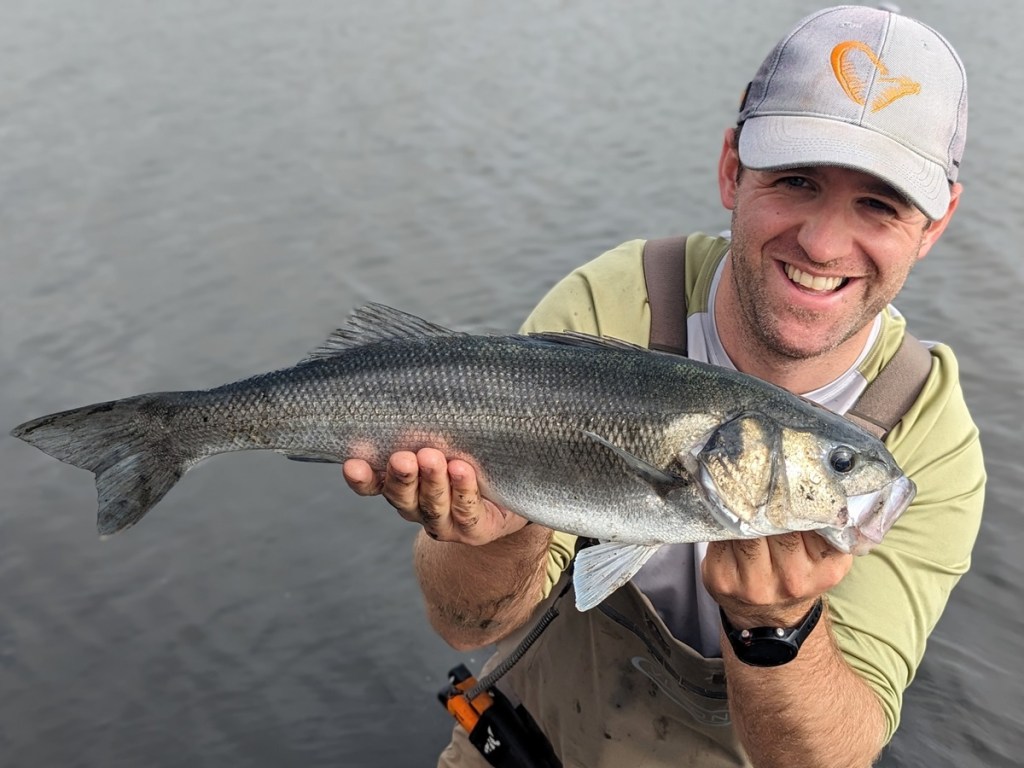
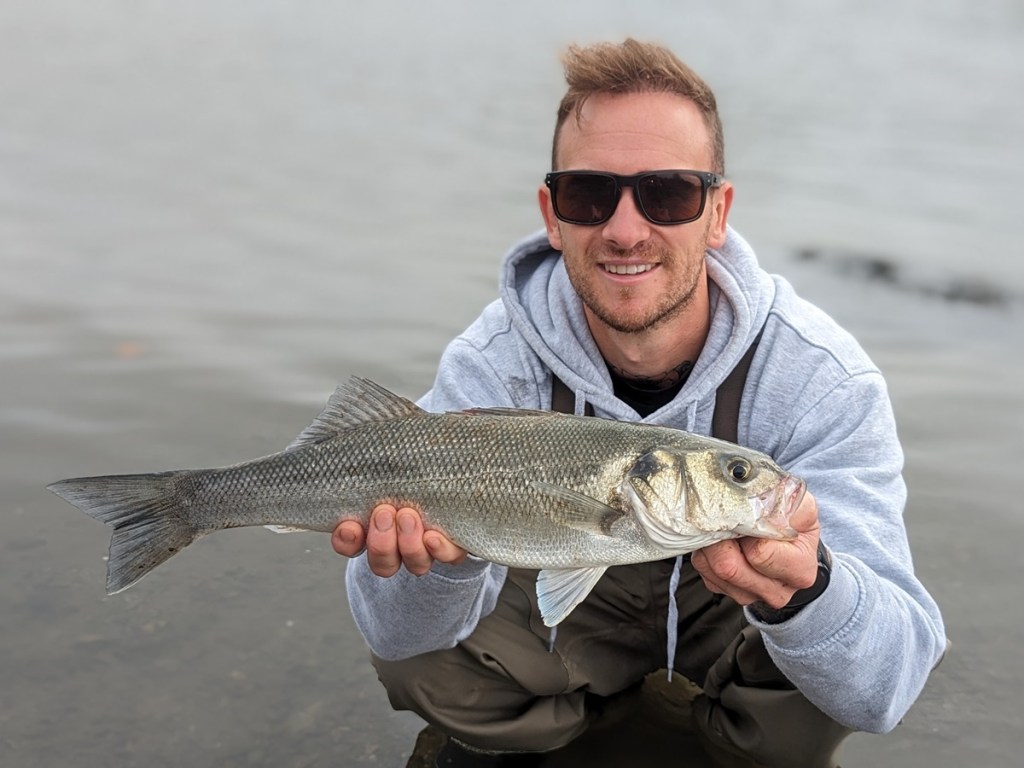
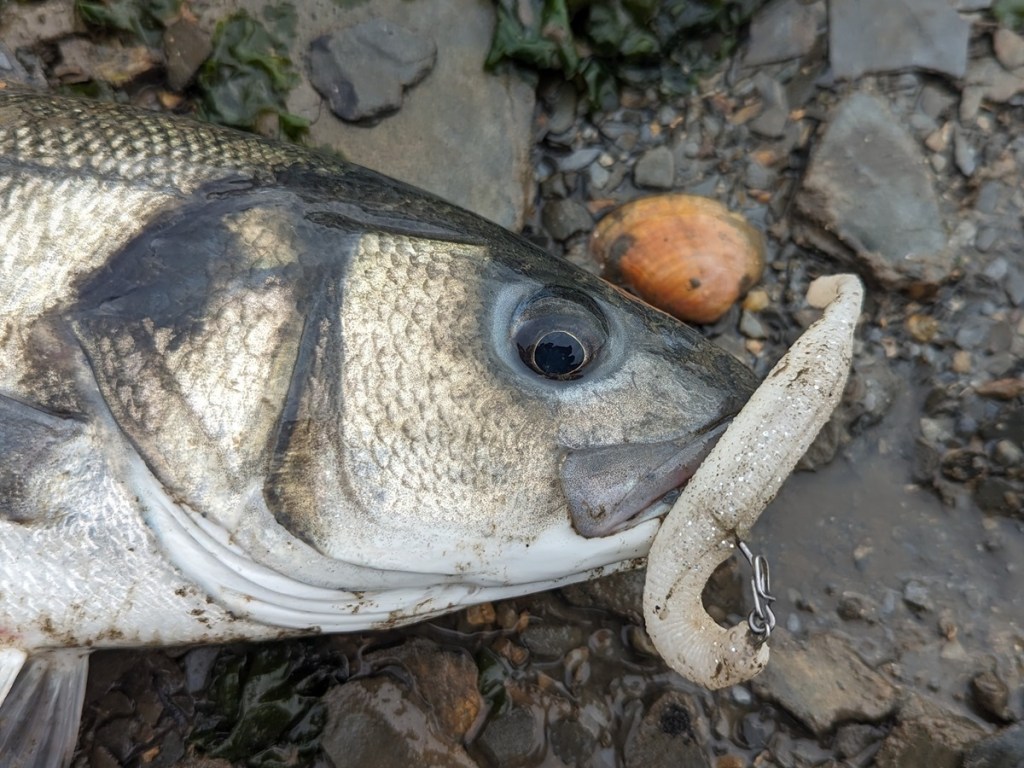
Find the bass positioned and patrolling in the creeks, hiding in the weedy margins and/or over the mudflats then, even if the water is extremely coloured, then you can still entice them to take a lure – with the soft plastics really coming into their own at this time of the year as you can see from the bass landed within one fine session for my clients (Paul and Michael in the slideshow above) during one fine session.
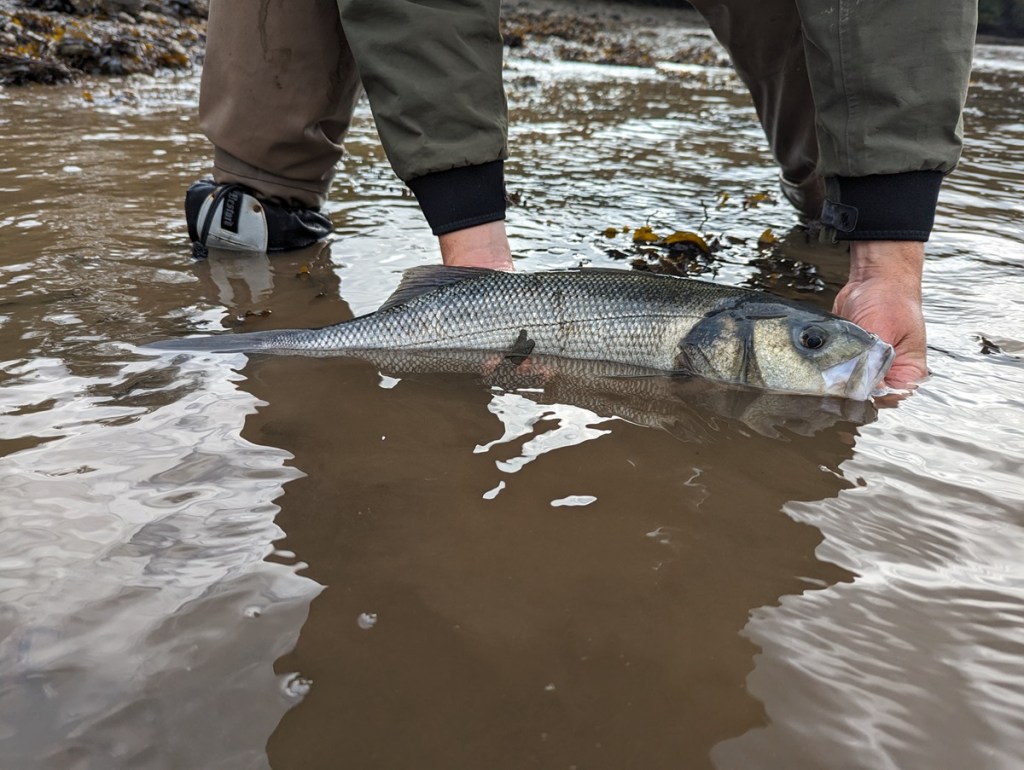
But when the water is really ‘chocolately’ such as in the photograph I took of an October client returning a bass above, the brighter Whites, Lemons, Limes and Two-Tone paddle tailed soft plastics will feature predominantly in our approach. Moreover, as I wrote in a recent blog post titled ‘Client Catches – The Use of Chartreuse‘ in conjunction with a number of ‘get arounds’ that I administer in such conditions (and that I reveal in full with the ‘Overcoming Adversity’ chapter of ‘Bass Lure Fishing – A Guide’s Perspective Volume 2‘) retrieving these lure types so that they occasionally ‘tap’ the seabed has been a winning tactic time and time again.



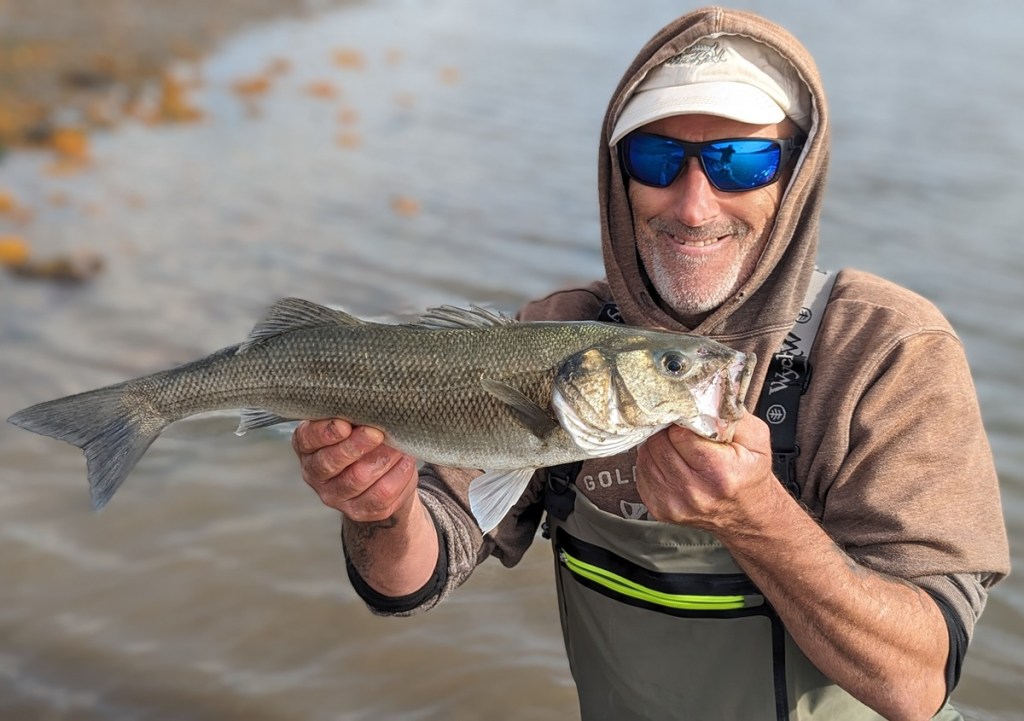
A definite feature of lure fishing for bass when things begin to become colder and more unsettled, is that the later into the autumn you go, the less ‘small fish’ you will encounter. In turn, what this means is that you can go fish-less for longer periods within a session without any kind of action, yet when a bass does come along it could be a real whopper such as the 62cm ‘brute’ that my client (Jon) found himself attached to below!

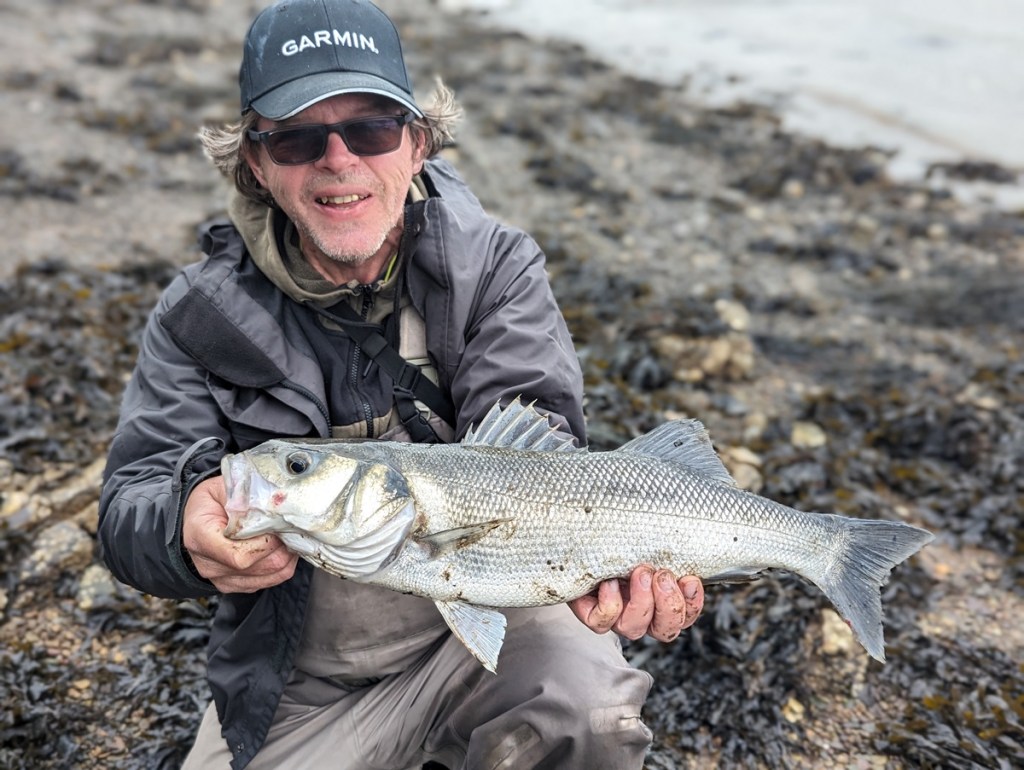
Despite the ‘iffy’ water clarity on all of the venues we fished due to the repeated low pressure systems moving through on a powerful jet-stream, there were clearly quite a fair few bass around the south Devon coastline. I was delving deep, not only into my repertoire of marks, but also in regards to the tactics and plainly ‘thinking outside of the box’ on occasion just to keep on catching… As an example, below is slideshow of captures, achieved by one of my 3 Day Package clients (Dave) who landed each of these three fantastic bass (one each day as it happens), in very, very contrasting conditions ranging from bright and sunny, to darkness, and also exceedingly brown water – great fishing my friend. 🙂


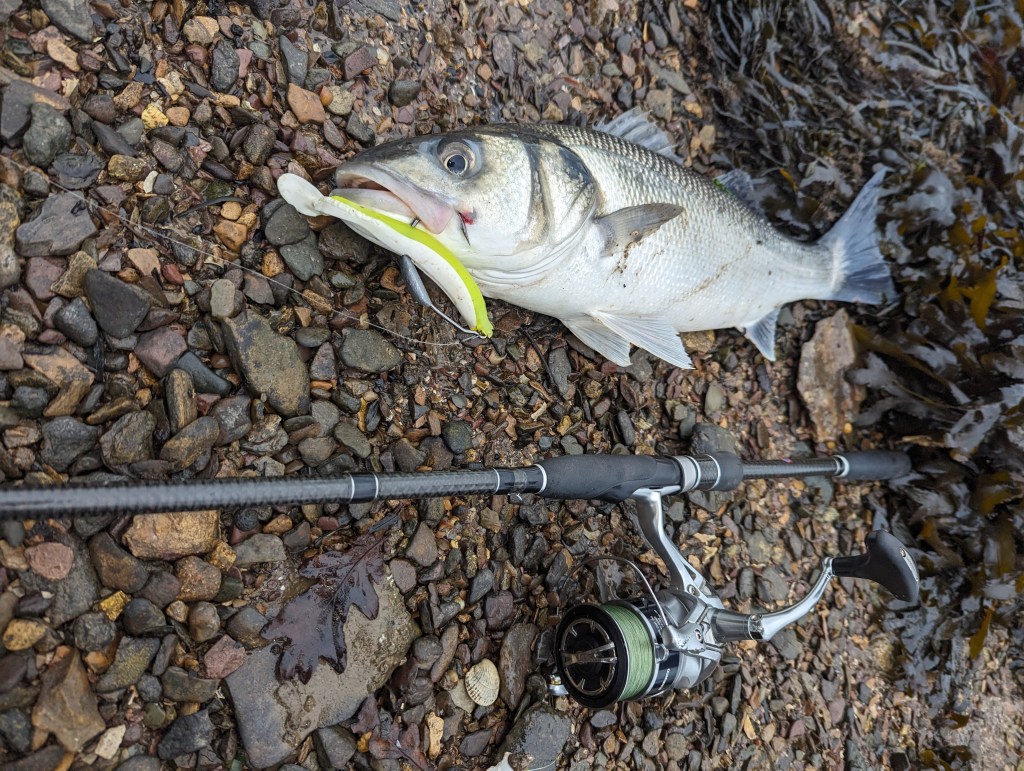
Yes, there were a few blanks mixed in there, but when things came together (which they did more often than not, due the efforts of my clients in tandem with some rather tenacious planning on my part) my clients extracted many, many magnificent bass from out of water clarity conditions that I know they really didn’t expect to. Indeed, I really would like to pay homage and say ‘Thank You’ to them for ‘going with it’ and for placing their faith in me as their guide in those moments – I massively appreciate it. Below is yet another slideshow with a prominence towards those captures that were achieved within some pretty extreme water clarity, wind, and wave conditions…


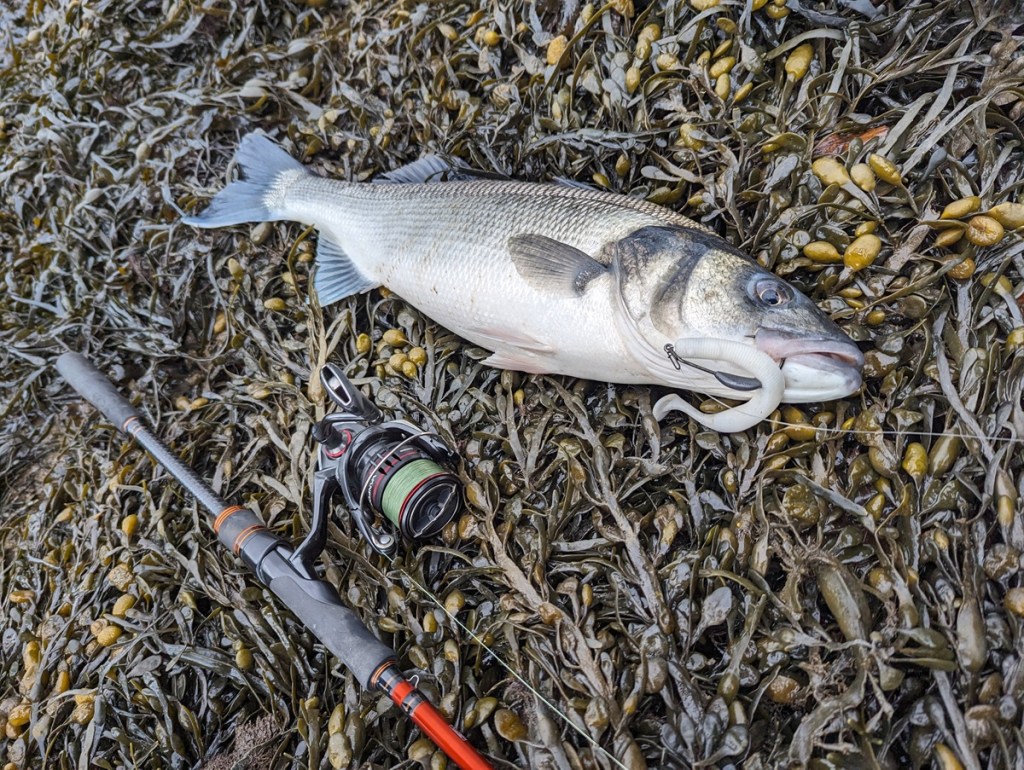
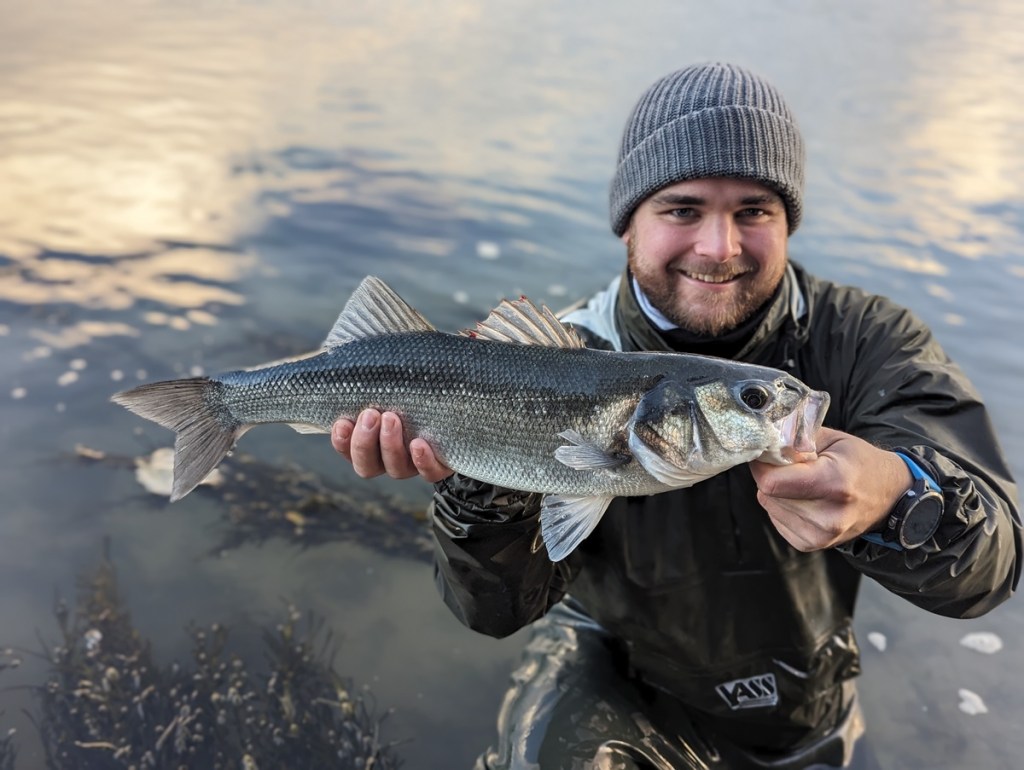


November
More of the same to end…
By the time November had ‘suddenly’ arrived, I had resigned myself to the fact that this was going to be, overall, quite an atypical season… My reasoning for this was that, firstly, in the six-and-half years that I have been professionally guiding, I haven’t experienced so few 1-2lb bass in a season – something I hope this isn’t a worrying trend… Now, as always, I do have a theory… Essentially, I think a greater percentage of the bass present along our southern and western coastlines (including the estuaries) decided to migrate to warmer water (as was always thought they do, looking for a sea temp of 10-11oC in order to breed) than have done so for many a year here in S. Devon.
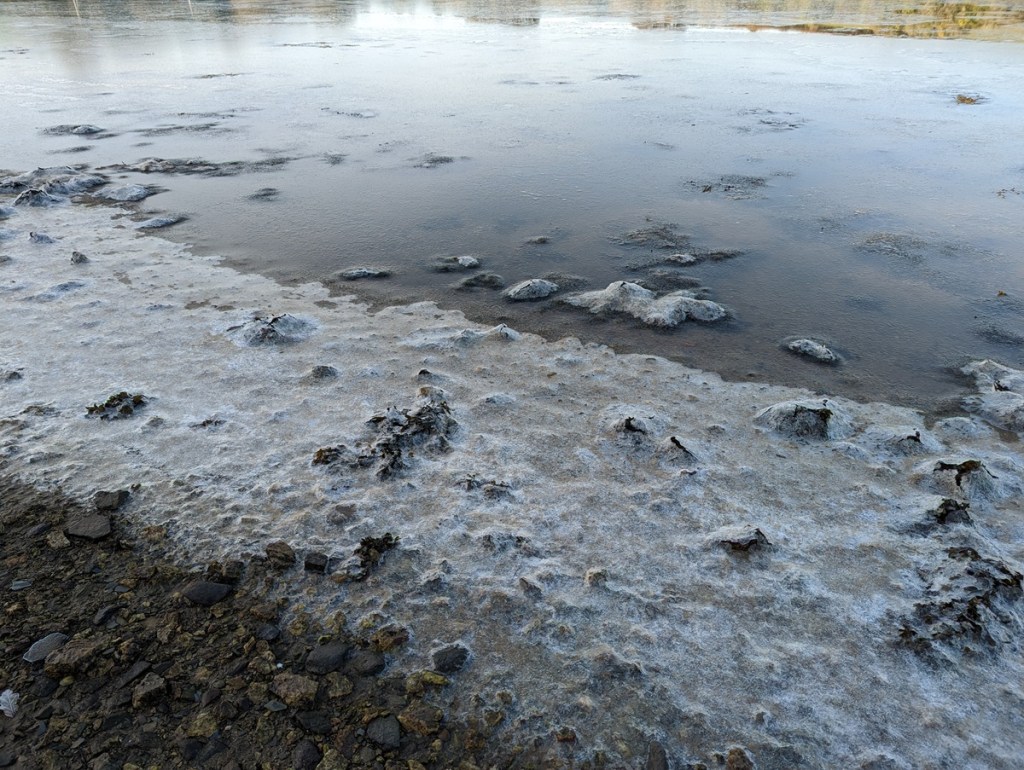
Secondly, I vividly recall sections of ice floating down the estuaries in December 2022, as well as swathes of foreshore being frozen solid (see below), plus, the sea temperature took quite a dive to 9.1oC before recovering again into January 2023. Associated to my theorem, is that the sea temperature rose very slowly in April following nothing remotely approaching sunny and warm as we had enjoyed in March 2022 when the sand smelt population went through the roof, and the number of bass corralling them were equally impressive in both numbers and size.
Overall then, it appears plausible that more smaller bass especially moved elsewhere, and less of them also moved back in when things did warm up, or when they did return it was short lived and highly transitory whilst following the early sand eel and mackerel shoals perhaps…? In regards to numbers of large bass for my clients in 2023 (bass over 68cm or 7-8lb), quite simply, I just wasn’t able to place them onto the type of venue(s) that have a habit of throwing them up when, critically, I need both the weather (wind direction primarily) and the ‘right’ tides to be aligned. So room for improvement you might say, and something that I will be thoroughly researching and developing over the coming winter and early-spring…
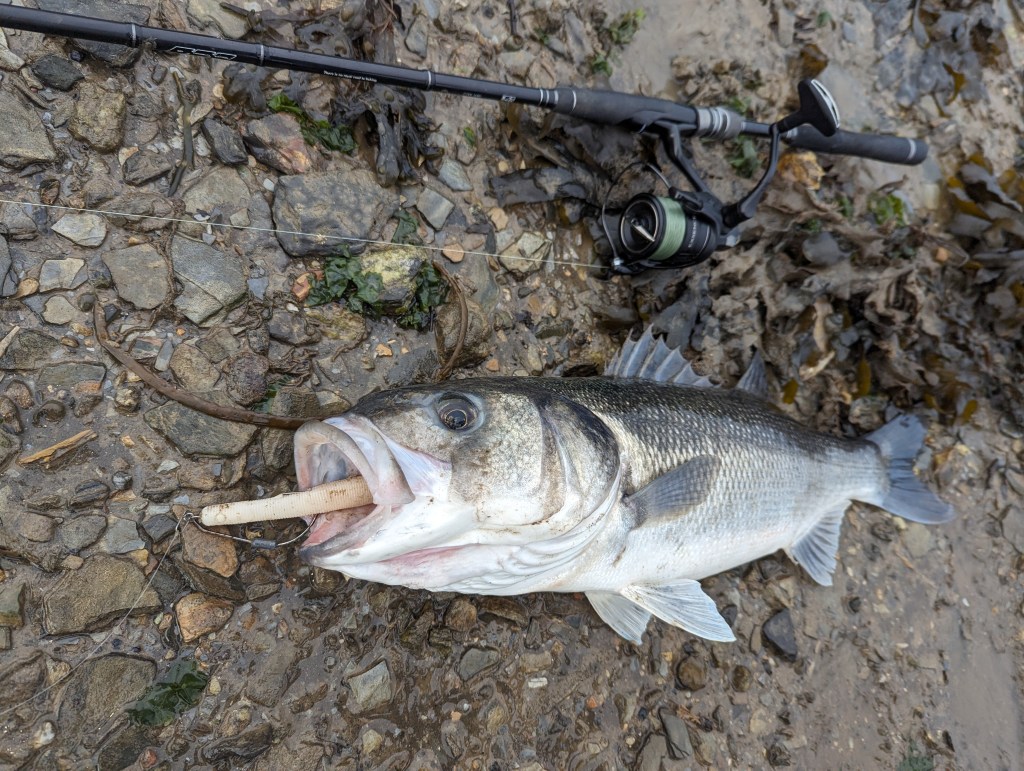
As you’ll read in the ‘My Year in Review 2033 – My Catches’, I did manage to pluck a couple of beefy old bass in the 70cm range from out of the substantial portfolio of marks that I will be adding to. But overall, and something that certainly bodes well for the future (we hope!) is that there was a ‘silver lining’ to the 2023 guiding season, in that a very pleasing number of bass landed and released that have been in the 50-57cm bracket – more than any other previous guiding season by quite some margin in fact.
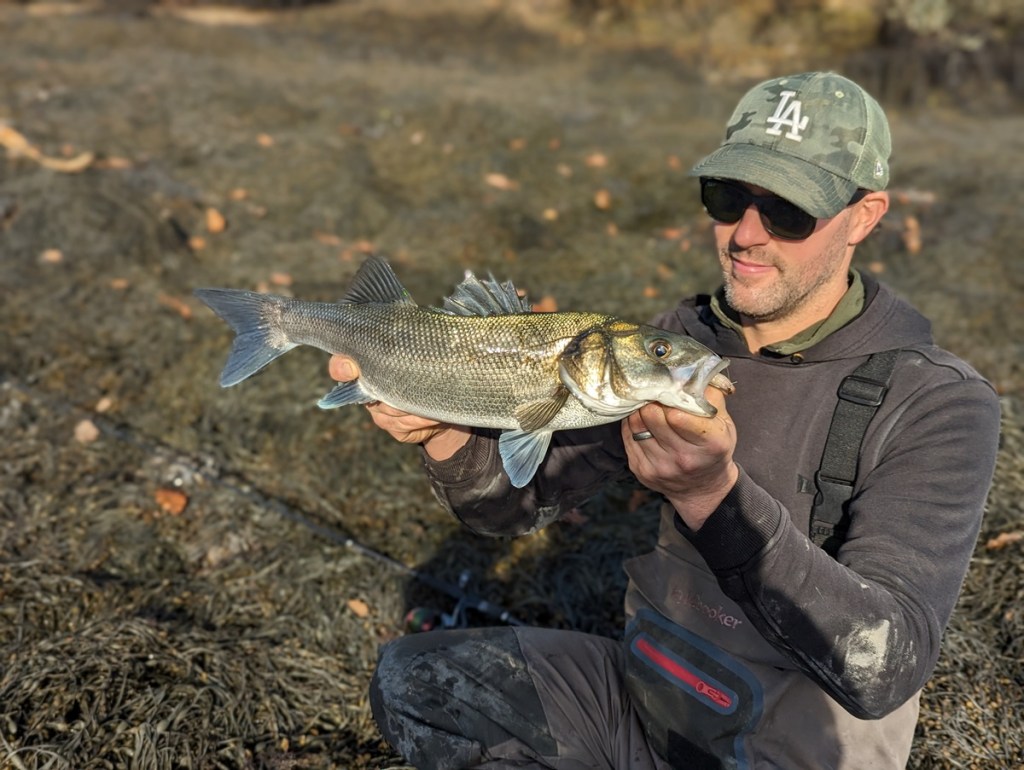


In the end, November saw my/our approach and our catch rate remaining on a par with October, with all of the estuaries I snoop around producing for me at some stage or another on the white or bright-coloured paddle tails. Why didn’t you fish more on the open coast you may ask? Because, categorically, it was either too rough, too dangerous, or too jammed up with weed fragments courtesy of my least favourite subject behind DIY in 2023 being, you guessed it, the weather – I promise that I will not mention it once in my next post as I know I’ve laboured the point!

In Summary
In summary, in highlighting the number of ‘windy days’ as a significant factor I would like to add that it has helped to ‘hone’ my mark selection skills. In addition to this, there were most definitely sessions and days on end when the fact that the wind was coming in from a specific direction actually assisted me to ‘narrow down’ where we should head, rather than me thinking ‘should I go here, here or here or… when the wind was/is non-existent (I hope that makes sense!).
Another reaffirming component to the 2023 guiding season is that my clients consistently managed to hook bass within water that was ridiculously coloured, to the extent that it had zero clarity on numerous occasions. This is a confidence thing and I totally understand that, which is why having a guide directing you is so important under such circumstances. But but I hope that in reading this post that many more of you will consider lure fishing for bass in brown, coffee, tea, grey, murky, chocolate-coloured seas. I really don’t even hesitate nowadays and I know that many of my clients have transferred this mindset back to their own localities and enjoyed success. Just brilliant!
Your Help Is Needed!
Your eyes do not deceive you – there is a proposal that has been brought forward by the Byelaw and Permitting Subcommittee (B&PSC) for the Devon and Severn Inshore Fisheries Conservation Authority (D&SIFCA) to allow a Commercial Fixed Netting Fishery throughout the entire Salcombe/Kingsbridge Estuary. If this were to be authorised, it would be absolutely disastrous on a multitude of levels (and not just the one(s) that I clearly have a vested interest in being that this beautiful area is on my doorstep) to all of the fish species, in addition to the equally important wildlife, sea life and bird species that frequent and inhabit its protected waters and foreshore.

So whether you are a former client, a prospective one, an angler who just loves to catch and hopefully release these truly majestic species of fish, or indeed someone who visits the area to fish for mullet, ray, gilthead bream, plaice or flounder to name the most prominent species, your help is requested and required to STOP this proposal before it can be approved, and ultimately become a precedent, benchmark, blueprint or yardstick that others will no doubt seek to replicate and exploit across the UK.
What can I do?
To gain an informed perspective and understanding of what is at stake here:
- Please read the Angling Trust’s initial and updated responses to these proposals: dated the 27th November 2023 (here) and the 20th December 2023 (here)
- Following this, I would recommend reading the B&PSC confirmed meeting minutes from the 31st August 2023 (here) in addition to the draft (V0.4) minutes for the meeting held on the 23rd November 2023 (here).
- Next, please read the INVITE TO RESPOND to the D&SIFCA’s Public Consultation (here) to the proposed amendments to allow a fixed net commercial fishery in The Salcombe/Kingsbridge Estuary. The consultation ends on the 19th January 2024.
- On the 3rd January 2024, The Angling Trusts’ Sea Angling Engagement Manager (Grant Jones) will be taking part in a BBC Spotlight interview on these proposals. On the 4th January 2024, The Angling Trust will be hosting an Online Angler Engagement Forum to present on their intended response to the consultation and also to conduct a Q&A session. This will give you more information and advice on how you can respond to this consultation. You can sign up for this event via the following link:
- https://events.teams.microsoft.com/event/d6f45e85-3302-475f-a7ad-a575ae15042d@7247e80e-4267-4086-a593-a3045dd9e505
- Finally, I implore you to join the Angling Trust (here) so that you are in a position to pledge your support to this, and the many other equally important present and future campaigns.

Thank you for reading and for all your support in 2023.
Marc Cowling

 South Devon Bass Guide Ltd